Alaska Network on Domestic Violence and Sexual Assault warns staffing gaps threaten rural forensic and advocacy response
Loading...
Summary
The Alaska Network on Domestic Violence and Sexual Assault and the Tundra Women's Coalition told the House Judiciary Committee that staffing shortages, contracting practices and reduced prevention funding have scaled back subregional sexual‑assault responses and increased reliance on Bethel and itinerant providers.
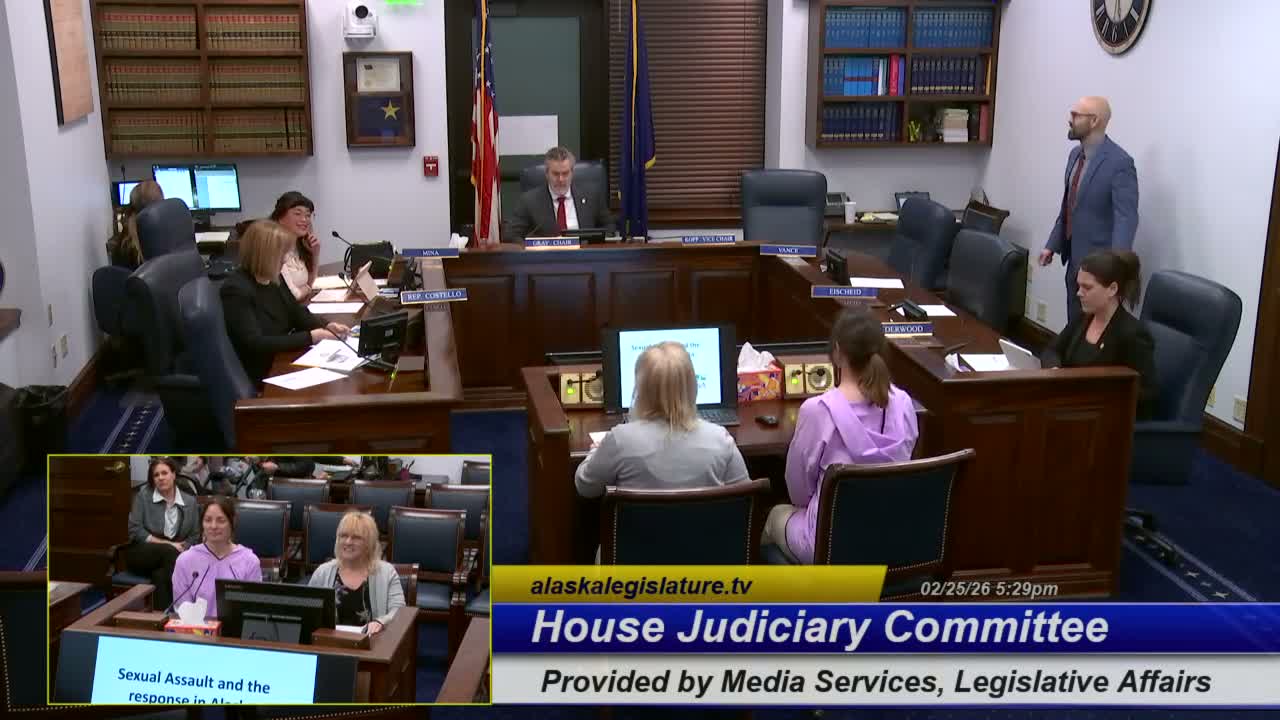
Representatives of the Alaska Network on Domestic Violence and Sexual Assault (ANDVSA) and the Tundra Women’s Coalition told the House Judiciary Committee on Feb. 25 that rural staffing shortages and post‑COVID shifts to itinerant contracting have limited local sexual‑assault medical and advocacy services and forced many victims to travel to Bethel for care.
Brenda Stanfield, executive director of ANDVSA, summarized statewide victimization‑survey results and program coverage. She said the network represents about 24–25 member programs, including 19 in rural Alaska and 16 off the road system, and that the Alaska Victimization Survey showed prior‑year rates of 4.3% (2010), 2.9% (2015) and 3.4% (2020), noting those figures refer to women only. Stanfield said ANDVSA is arranging a 2025 survey to refine trends and asked the committee for additional victim‑services funding.
Eileen Arnold, executive director of the Tundra Women’s Coalition in Bethel, described a TeleSafe pilot allowing subregional clinics to telehealth to a Bethel provider for forensic evidence collection and advocacy, funded with an Office for Victims of Crime (OVC) grant awarded in 2019. Arnold said TeleSafe operated briefly in communities such as Hooper Bay and Ammonic and increased victim participation, but staffing shortages in local clinics and YKHC’s move to contracting itinerant providers have made the model difficult to sustain.
Arnold cited local statistics including a 2024 supplemental report rate of 408 per 100,000 population in her region and said reported cases disproportionately involve Alaska Native people. She described a recent prosecution from her region that produced a 268‑year sentence based on testimony rather than forensic evidence, and said embedding medical services with victim advocates remains critical in rural settings.
During Q&A, Representative Costello asked about a backlog of sexual‑assault kits and the Choose Respect prevention campaign. Stanfield said the previous kit backlog has been cleared, labs now test kits within statutory timelines (she estimated 120 days), and an app allows survivors to track kit status; she also said Choose Respect previously included roughly $30 million in multiagency funding and has been discussed for revival but lacks identified investment to restart at that scale.
The presenters asked lawmakers for ongoing funding to restore prevention and survivor services and for support addressing rural workforce and contracting challenges. The committee did not take formal action during the Feb. 25 session.