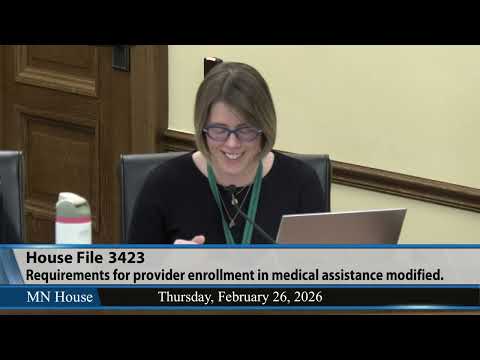
Committee adopts DE1 for provider‑enrollment bill, lays HF3423 over for further work

Human Services Policy and Finance Committee · February 26, 2026

Get AI-powered insights, summaries, and transcripts

Subscribe
AI-Generated Content: All content on this page was generated by AI to highlight key points from the meeting. For complete details and context, we recommend watching the full video. so we can fix them.

Summary

The Human Services Policy and Finance Committee adopted a DE1 that recodifies and tightens Medical Assistance provider‑enrollment rules, then laid House File 34‑23 over for possible inclusion as members and providers negotiate financial‑capacity and moratorium language.

Representative Hicks introduced House File 34‑23 and said the bill’s core aim is to tighten Medical Assistance (MA) provider enrollment so that providers can demonstrate they have the capacity to deliver services. "The heart of this bill is really to tighten up enrollment," Hicks said, stressing protections for clients, workers and taxpayers.

House Research staff member Annie Mach outlined the DE1, describing two sets of changes: recodification of existing enrollment requirements into new statute sections and substantive additions. The amendment requires the Department of Human Services (DHS) to report annually on site visits (pre‑, post‑ and unannounced), establishes categorical risk levels for providers (limited, moderate, high), expands background‑study requirements, explicitly authorizes unannounced site visits, and in certain circumstances requires a surety bond. It also adds a new financial‑capacity verification and allows the commissioner to require provider compliance programs and revalidation schedules, including mandatory three‑year revalidation for high‑risk providers.

Online and in‑person providers warned the committee the new requirements could strain small, community‑based organizations. Joel Bakken, executive director of Solutions Behavioral Health, said HF3423’s initial draft would have required EIDBI providers to maintain 90 days of payroll reserves. "If this legislation is focused on strong fiscal responsibility and meaningful oversight for MA providers, I stand with you. What I cannot accept is the idea that credible EIDBI providers must bear the burden of fixing DHS's fraud problem," Bakken said, arguing the sector operates on thin margins.

Sandra Bond, president of the Minnesota Association of Residential Service Homes, testified that expanded enrollment and compliance expectations imposed uniformly on small adult foster care homes — many of which serve one to four residents — could create unfunded mandates under Minnesota’s flat‑rate reimbursement system and risk provider exits and resident displacement.

Ellie Skelton, executive director of Touchstone Mental Health, said the amendment appears to address the 90‑day payroll language but urged lowering the proposed surety bond threshold (described in testimony as $100,100,000 or 10% of Medicaid billing in draft language) and clarifying moratorium language so that planned new settings for existing providers would not be unintentionally blocked.

Members and chairs agreed to continue technical and policy work. Chair Schumacher noted much of the DE1 is technical recodification and described section 10’s moratorium language as permissive in its current form. The committee adopted the DE1 amendment by voice vote and laid HF3423 over for possible inclusion so sponsors and stakeholders can continue refining financial‑capacity, bond, and moratorium provisions.

Next steps: the author and House Research will continue negotiations with providers and chairs to refine thresholds, clarify moratorium scope, and address outstanding prepayment review and payment‑withhold language before the bill advances.