
Callan tells Alaska Senate Finance panel that lower draw rates improve long‑term payouts; 5% is volatile
Get AI-powered insights, summaries, and transcripts
Sign Up Free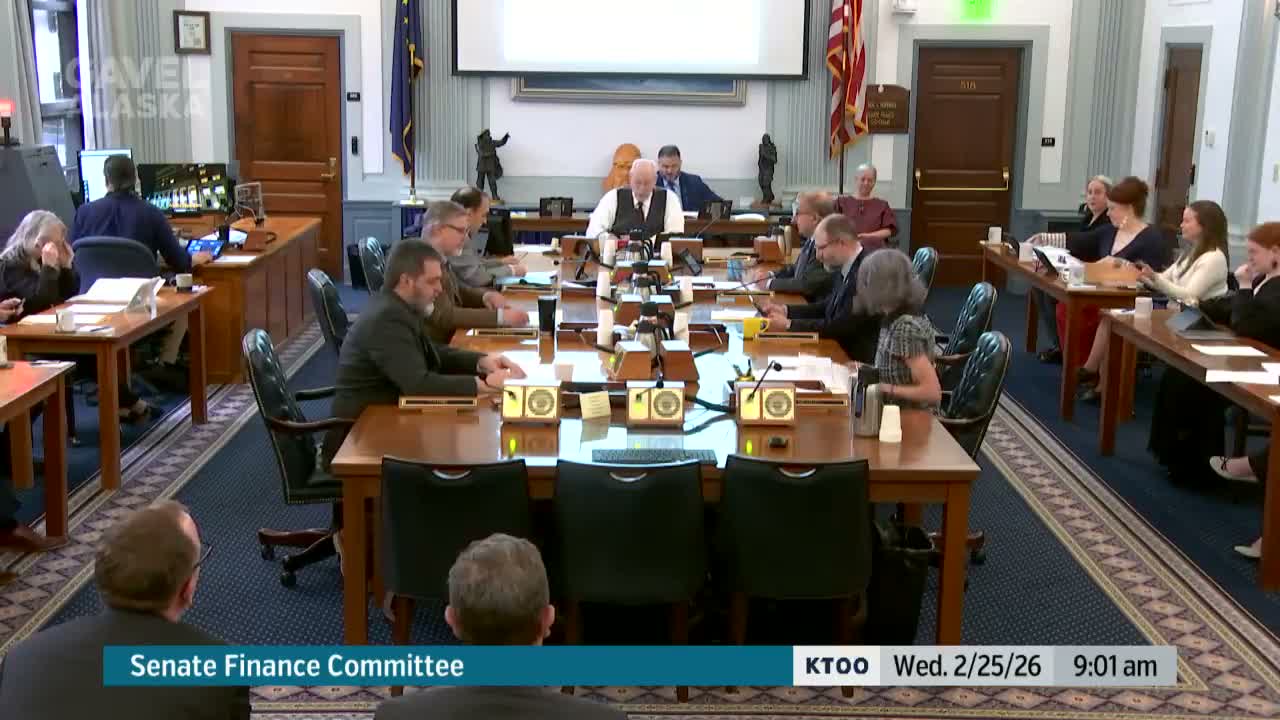
Summary
At a Feb. 25, 2026 Senate Finance Committee hearing, Callan presented the Alaska Permanent Fund’s 2025 performance (12.5%) and simulations showing a 4.5% draw better balances near‑term payouts with long‑term sustainability than a 5% or 6% rule; committee members pressed on allocation, fees and Department of Revenue oversight.
Greg Allen, CEO of Callan, and Callan Senior Vice President Steve Senter told the Alaska Senate Finance Committee on Feb. 25, 2026, that the Alaska Permanent Fund returned 12.5% in 2025 and that the fund’s current strategic asset allocation produces an expected 10‑year annualized return of about 7.3%.
Senter, presenting benchmark and fund results, said non‑U.S. equities drove much of 2025’s gains and that the fund’s blended allocation — roughly one‑third public equities with sizable private market allocations — has produced strong long‑term results while producing short‑term variance versus peer groups. "The Permanent Fund returned 12.5% last year, slightly ahead of its total fund target of 12.2%," Senter said.
The core of Callan’s presentation was an analysis of potential draw (withdrawal) rules and their interaction with the fund’s two‑account structure and its Earnings Reserve Account (ERA). Callan described the current draw formula as applying a chosen draw rate to the trailing average of the fund (the first five of the last six fiscal‑year end market values), which makes effective payouts lower and more stable than applying the rate to current market value.
Using historical simulations and Monte Carlo projections, Callan said a 5% nominal draw would produce higher near‑term distributions in many years but also a materially larger probability that the ERA would limit payouts in bad markets. In contrast, a 4.5% draw often results in a smaller short‑term distribution but can lead to a larger fund over decades and thus higher nominal payouts in the long run. "If you can hold on at a smaller draw, you'll actually be able to pay out more in the future than you will under a 5% draw," Allen said.
Callan illustrated the trade‑offs with multiple scenarios: with a 4.5% draw the median projected market value in 10 years rises relative to the 5% and 6% scenarios; a 6% draw raises median payouts in some model years but substantially increases the chance that the ERA will constrain distributions and raises the probability of low worst‑case outcomes.
Committee members pressed Callan on specifics. Senator Keel asked whether the fund’s selection within equities, not just the allocation, affected performance; Senter said underweights to the largest U.S. mega‑cap stocks that materially drove recent U.S. market returns were a factor. "The Magnificent 7 effect" was cited by Senter as one driver of short‑term divergence from some peers.
Senators also asked about fee impacts. Allen said reported fund returns are net of fees and that, while public‑market implementations can be low cost, private markets typically carry higher, less negotiable fees; he added that the Permanent Fund’s scale gives it lower fees than many peers.
Law, governance and oversight questions surfaced as well. Chair Stedman and others raised concerns about a prior Department of Revenue commissioner’s conduct, saying the commissioner had not always followed fiduciary obligations. Callan said it consults to several state boards but is not the adviser for every Department‑managed asset pool and that it was not involved in certain Department decisions raised by committee members.
The committee took no formal action during the presentation. Chair Stedman said members may request follow‑up scenario runs and further consultation with Callan as they consider possible statutory changes on draw rules and related protections. The committee adjourned at about 10:35 a.m.