
Committee hears bill to modernize Alaska's health information exchange; questions on fees, privacy and analytics
Get AI-powered insights, summaries, and transcripts
Subscribe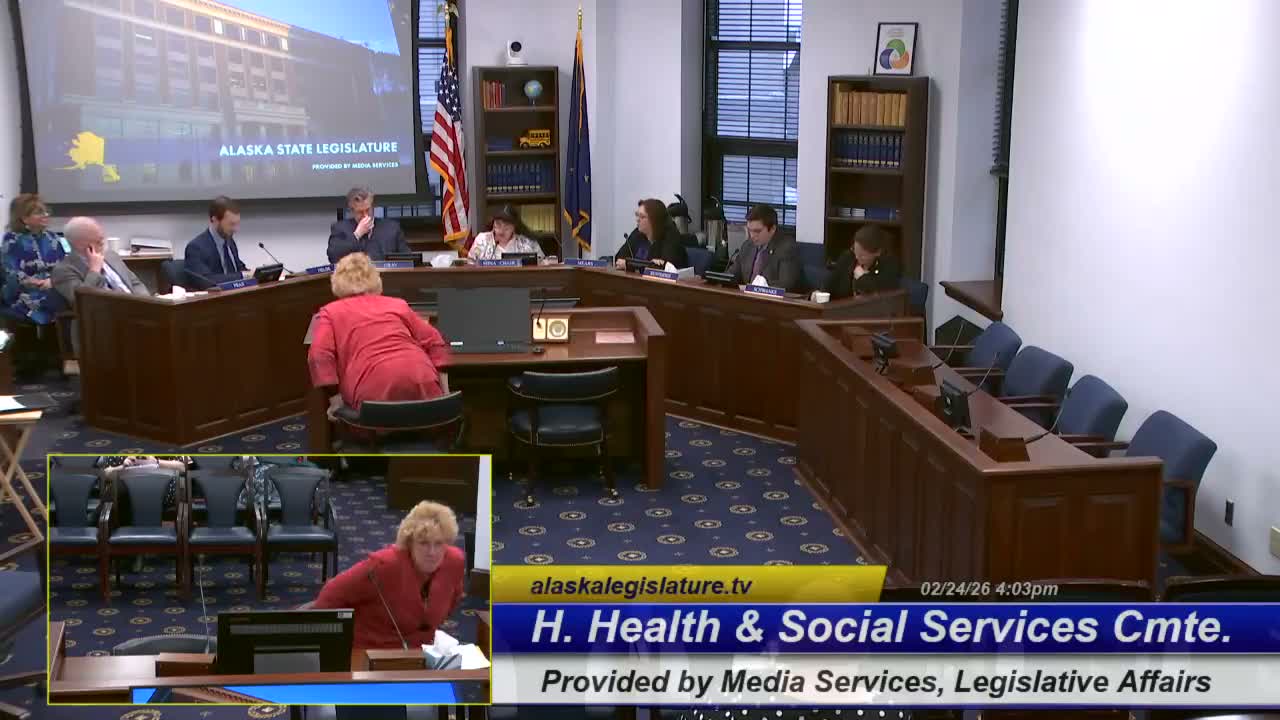
Summary
House Bill 285 would update Alaska's Health Information Exchange law to clarify department duties, data uses, patient authorization options and add behavioral health representation to governance. Testimony focused on patient control, EMR connection fees, de-identification limits and system reliability.
Juneau — The Alaska House Health and Social Services Committee held an initial hearing on House Bill 285 on Tuesday, a committee-sponsored bill to modernize the state's Health Information Exchange (HIE) statute.
Kendra Stika, executive director of Healthy Connect Alaska (the nonprofit that administers the HIE), testified that HB285 updates the 2009 framework to reflect modern electronic health record systems, adds behavioral health representation to the governing body and clarifies how the Department of Health can permit authorized uses of HIE data. "Health information exchange is really based on trust," Stika said. "Cleaning up the language so it's very clear and transparent how data in the Health Information Exchange can be used" will help providers and patients.
Why it matters: Updated statute language could make it easier to use HIE data for care coordination, program eligibility and population health while preserving patient privacy, but the committee pressed witnesses on unresolved questions about connection costs, analytics limits and system reliability.
Fees and sustainability: Representative Gray asked whether the bill addresses the longstanding problem of EMR vendors charging high fees to connect to exchanges. Stika said early membership fees proved unpopular and that Healthy Connect currently operates largely under a Department of Health contract; the bill preserves authority to charge fees where a payer or provider receives clear value but cannot by itself control third-party EMR vendor charges. Outside counsel Carolyn Hyman noted that the federal 21st Century Cures Act includes provisions intended to reduce barriers to record access and said she would work with Healthy Connect to ensure participants could invoke federal measures when negotiating connection fees.
Privacy, de-identification and analytics: Representatives asked whether de-identified HIE data can validate regional clinical trends. Stika said de-identification under HIPAA standards is possible but can limit geographic and demographic detail and that some organizations can run analyses on their own data but statewide de-identified analytics may have data gaps. She cautioned that de-identification rules can make it difficult to obtain fine-grained regional statistics.
Reliability and shared technology: Committee members asked about system debugging and data quality. Stika described Healthy Connect's participation in a multi-state shared-technology consortium that provides scaled security, monitoring and quality-control tools; she said the consortium model offers more robust protections than a small, homegrown system.
Next steps: The committee set HB 285 aside for a future hearing and announced an amendment deadline (March 4 at noon).