Alaska committee urges federal flexibility on Rural Health Transformation Program timeline
Loading...
Summary
Lawmakers discussed House Joint Resolution 32 asking Alaska's governor and congressional delegation to seek more time and flexibility from CMS so the state can pass and implement multiple bills tied to Rural Health Transformation Program funding; members debated priorities, implementation capacity and language on sustainable financing.
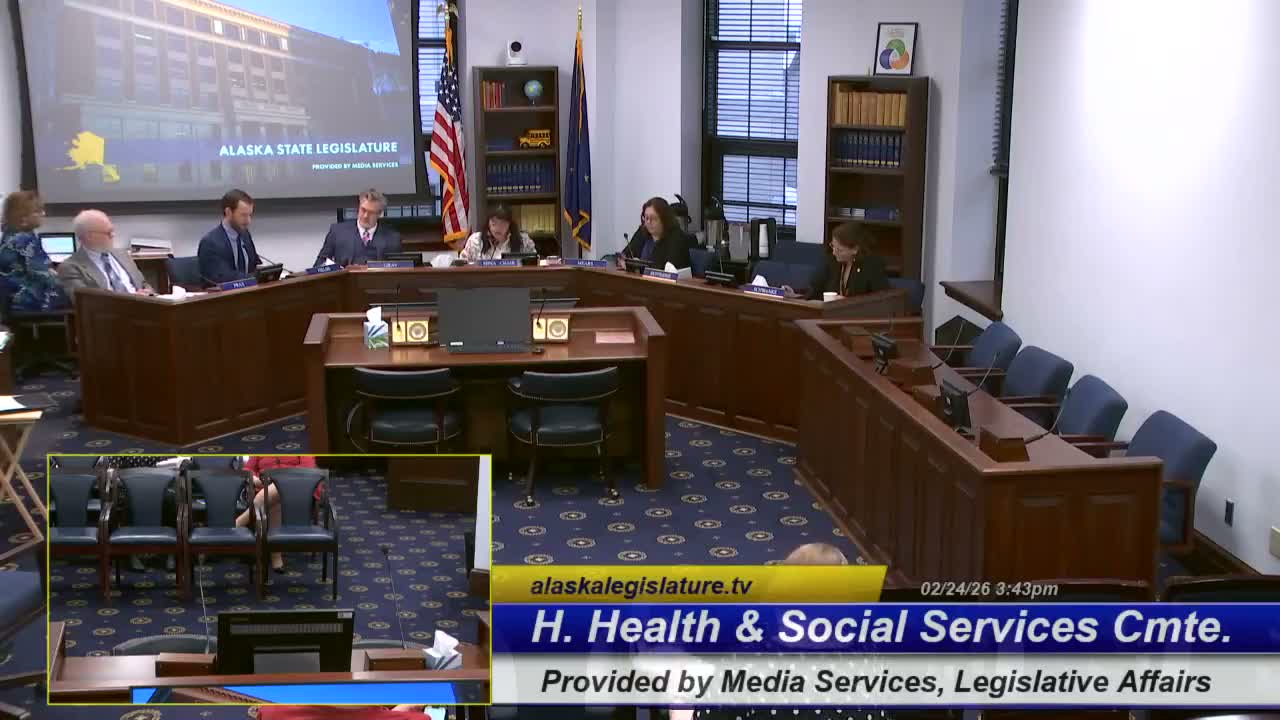
Juneau — The Alaska House Health and Social Services Committee opened an initial hearing on House Joint Resolution 32 on Tuesday, a committee-sponsored measure asking the governor and the state's congressional delegation to seek additional time or flexibility from the federal Rural Health Transformation Program (RHTP) requirements.
Laurie Winghire, the legislature's health care liaison, told the panel the RHTP application ties federal scoring to passage and implementation of multiple state bills (she said about six related bills were cited) and that the current timeline in the notice of funding opportunity leaves Alaska little time to pass and implement the measures before CMS's deadlines. "What we were hoping is that the governor and the congressional delegation ... will work with CMS and others to perhaps extend that time frame to be the 2028 to give you a full legislative session," Winghire said.
Why it matters: Committee members said they want Alaska to be competitive for federal RHTP dollars, but they also warned that rushing complex legislation and regulatory changes could produce poor outcomes or leave agencies unable to implement new programs. Several members said the resolution should focus narrowly on asking for more implementation time rather than endorsing a long list of programmatic priorities.
Discussion highlights: Representatives raised several recurring concerns during the hearing. Representative Ruffridge pressed whether the CMS scoring requirement included not only passage but also implementation, noting that regulatory packages, agency rulemaking and interagency coordination could extend the timeline; Winghire replied that the program's implementation window was limited (she described roughly a one-year implementation expectation after passage) and suggested staggering implementation dates to reduce the burden on state agencies.
Representative Fields criticized the political uncertainty of relying on federal executive decisions and questioned whether the federal scoring criteria were applied fairly; other members pushed back, noting that the Department of Health and the state's application also shaped the package. Winghire told the committee the notice of funding opportunity explicitly awarded full points for passed or implemented bills and partial points for introduced bills, which drove the inclusion of certain compact and licensure measures.
Language and scope concerns: Representative Schonke warned the resolution mixes multiple priorities and used language he said might commit the legislature to long-term spending: he questioned a provision that asks for 'sustainable financing models that ensure program benefits continue beyond the five-year federal funding period,' asking whether the phrase could be read as a state commitment to ongoing funding after federal dollars end. He also asked how tribal health systems and private primary care providers were expected to fit into the collaboration language and whether terms such as "culturally competent" need clearer definition.
Next steps: Chair Representative Mina instructed staff and the health-care liaison to shorten and refine the resolution to emphasize flexibility and an extension request; public testimony was left open for a future hearing. The committee set HJR 32 aside for a follow-up hearing and announced amendment deadlines for March 4. The resolution will return for further committee consideration.
Who said it (selected): Laurie Winghire, health care liaison for the legislature: "...we would have until December 2028 to have the implementation." Representative Schonke: "...there's a lot of different things in here, moving parts, asking a lot of different entities and groups to do a lot of different things." Representative Fields: "...I'm not gonna support [federal] policy without due diligence."
Ending: The committee left HJR 32 open for revision and deferred public testimony; the panel scheduled further consideration for a later meeting and set an amendment deadline of March 4.