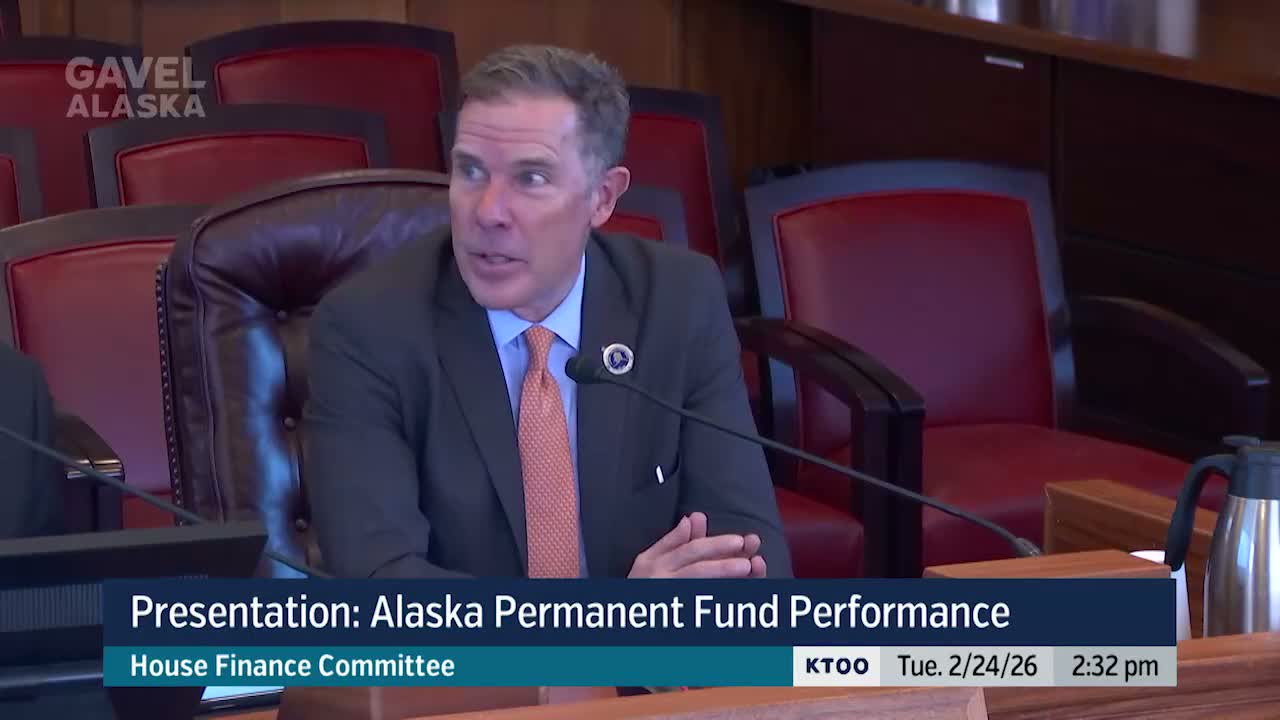
Callan tells Alaska House Finance Committee a 4.5% Permanent Fund draw is more sustainable than 5%
Loading...
Summary
Callan consultants told the House Finance Committee on Feb. 24 that the Alaska Permanent Fund outperformed long-term targets but that a 4.5% statutory draw is materially more sustainable than 5% or higher, reducing the likelihood of exhausting the Earnings Reserve Account and risking future payouts.
Juneau — Callan consultants Greg Allen and Steve Center briefed the Alaska House Finance Committee on Feb. 24 on the Alaska Permanent Fund’s performance and on modeling of different statutory draw rates, saying a lower draw of about 4.5% is more likely to preserve the fund’s purchasing power and reduce the probability that the Earnings Reserve Account (ERA) would be exhausted in a market downturn.
Allen told the committee that as of late 2025–early 2026 the fund’s market value exceeded $90 billion and that 2025 produced a strong single‑year return; the Permanent Fund recorded a roughly 12.5% return in 2025, he said. He described the statutory draw formula in current law — a 5% application to an average of first five of the last six fiscal‑year market values — and explained how the five‑year smoothing means the effective payout is typically closer to about 4.6% in rising markets.
The consultants showed historical back‑tests and forward Monte Carlo simulations of 4.5%, 5% and 6% draws. ‘‘4.5% is sustainable,’’ Allen said, summarizing his view of the model results. He added that a permanently fixed draw set in a constitution (rather than changed by statute) would reduce political volatility in future draw decisions.
Why it matters: the Permanent Fund’s net distributions help fund a substantial share of the state budget; Callan stressed that small differences in payout rates compound through time and that lower near‑term payouts can produce higher dollar flows for future years. Allen said his historical simulations show that holding a lower draw can, over roughly a decade, lead to larger dollar distributions than a higher draw that erodes the fund’s market value.
Committee members pressed the consultants on portfolio composition and policy tradeoffs. Center reviewed 2025 market drivers — non‑U.S. stocks led public markets, private markets showed modest returns, and real estate lagged due to rising interest rates and office/retail weakness. The Permanent Fund’s current target allocations listed by the consultants included roughly 11% to real estate, ~32% public equities and about 20% public fixed income; private equity and private credit were noted as sizable and long‑term allocations.
Representative Eliza Bynum asked whether the fund could be used to invest directly in Alaska infrastructure. Allen said the Permanent Fund is permitted to invest in Alaskan projects but must meet fiduciary (prudent‑person) standards and typically uses external underwriters or managers for direct deals; he suggested the legislature could alternatively appropriate ERA funds for in‑state projects if the goal is direct state‑led investment.
Callan noted governance tradeoffs as well: the two‑account system (principal and ERA) smooths payouts but leaves some decisions exposed to statutory appropriations. Allen warned that ad hoc withdrawals or large one‑time appropriations from ERA reduce the cushion available during market downturns.
Board and trust context: the consultants said peer comparisons show the Permanent Fund’s long‑term returns have kept pace with the stated CPI+5 target, though shorter horizons vary. Callan told the committee the Mental Health Trust recently moved its draw from 4.25% to 4.5% (with Callan advice), and that many large endowments target draw ranges in the mid‑4% range as a sustainable yield.
What’s next: the committee thanked the presenters and adjourned; they will meet again on Feb. 25, when House Bill 91 (marijuana tax and retailer registration language) is slated for consideration.
Accuracy note: quotes and attributions in this article are drawn from the committee transcript of the Feb. 24, 2026 hearing. When the transcript contained inconsistent institutional names for the consultant firm, presenters identified themselves as Callan during the hearing; this article uses the firm name callers used on the record.