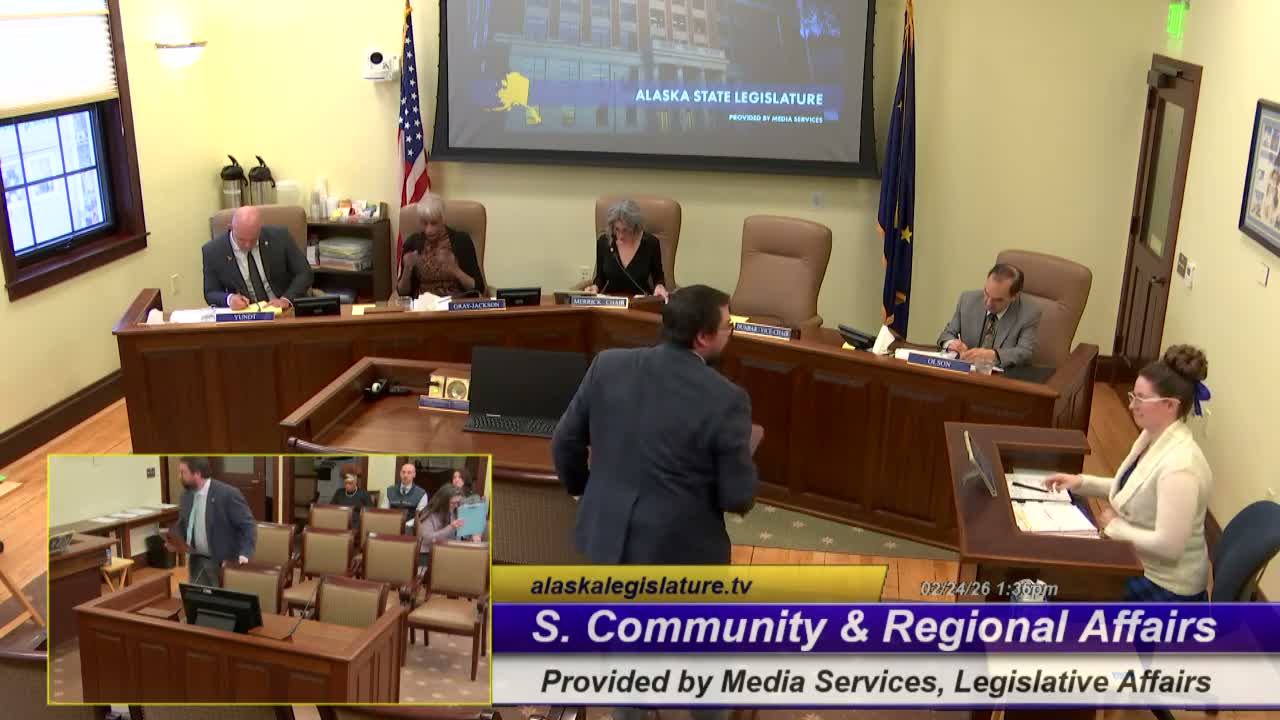
Senate committee hears testimony on bill to allow local use of automated traffic safety cameras
Loading...
Summary
Senate Bill 235 would let local governments opt to use automated speed and red-light cameras; proponents cited a recent rise in Anchorage traffic deaths and evidence from other cities, while the committee took no final vote and set the bill aside for further consideration.
ANCHORAGE, Alaska — The Senate Community and Regional Affairs Committee heard testimony Feb. 24 on Senate Bill 235, which would allow—but not require—local governments to use automated traffic safety cameras for speeding, red-light and railroad-grade crossing enforcement.
Senator LB Grama Jackson, sponsor of the bill, told the committee that Anchorage has seen a troubling uptick in serious crashes and fatalities. “Over the last 2 years, a record number of 15 people have lost their lives on Anchorage roadways. That is roughly 1 death every 3 weeks,” she said, arguing automated enforcement could help where consistent in-person traffic enforcement is difficult.
Jamie Bagley, staff to Senator Grama Jackson, provided a sectional analysis, saying the bill would add a paragraph to AS 29.10.200 limiting home-rule powers and create AS 29.35.143 to reserve regulation of automated traffic safety enforcement cameras to the state. Bagley said the statutory changes would cover both home-rule and general-law municipalities and apply to speed, red-light and railroad crossing cameras.
Three invited witnesses supported the bill during the remote hearing. Lindsay Hajduk, a resident and volunteer with Bike Anchorage (speaking in a personal capacity), described Anchorage as experiencing a “transportation safety crisis” and said Vision 0 strategies identified automated enforcement as a key tool. “Our community is suffering from a transportation safety crisis,” Hajduk said, noting recent pedestrian and bicycle fatalities and limited traffic-enforcement staffing.
Nancy Pease, an urban and land-use planner who serves on the Rabbit Creek Community Council, pointed to evidence she said demonstrates camera effectiveness, citing a Chicago study that showed a “30 to 50% reduction in severe injury crashes” after red-light cameras were installed. Pease argued automated cameras are cost-effective and change driver behavior by increasing the certainty of being caught.
A final invited testifier identified in committee paperwork as Jade Powell and speaking as Jay Powell said North Star Community Council members have concerns about speeding and noise and urged keeping both red-light and speed enforcement options in the bill. Powell recounted a near-miss in which a car “raced out in front of her and just nearly hit her,” saying local communities need tools to prevent similar incidents.
Committee members invited public testimony; no members of the public in the room or online offered remarks. The committee did not take a final vote on SB 235 and set the bill aside for further consideration.
What happens next: The committee will consider SB 235 in future session business; no date for additional action was announced at the hearing.