
Alaska News Coalition chair Larry says small papers are 'dying' as printing, ads and readers fall
Get AI-powered insights, summaries, and transcripts
Subscribe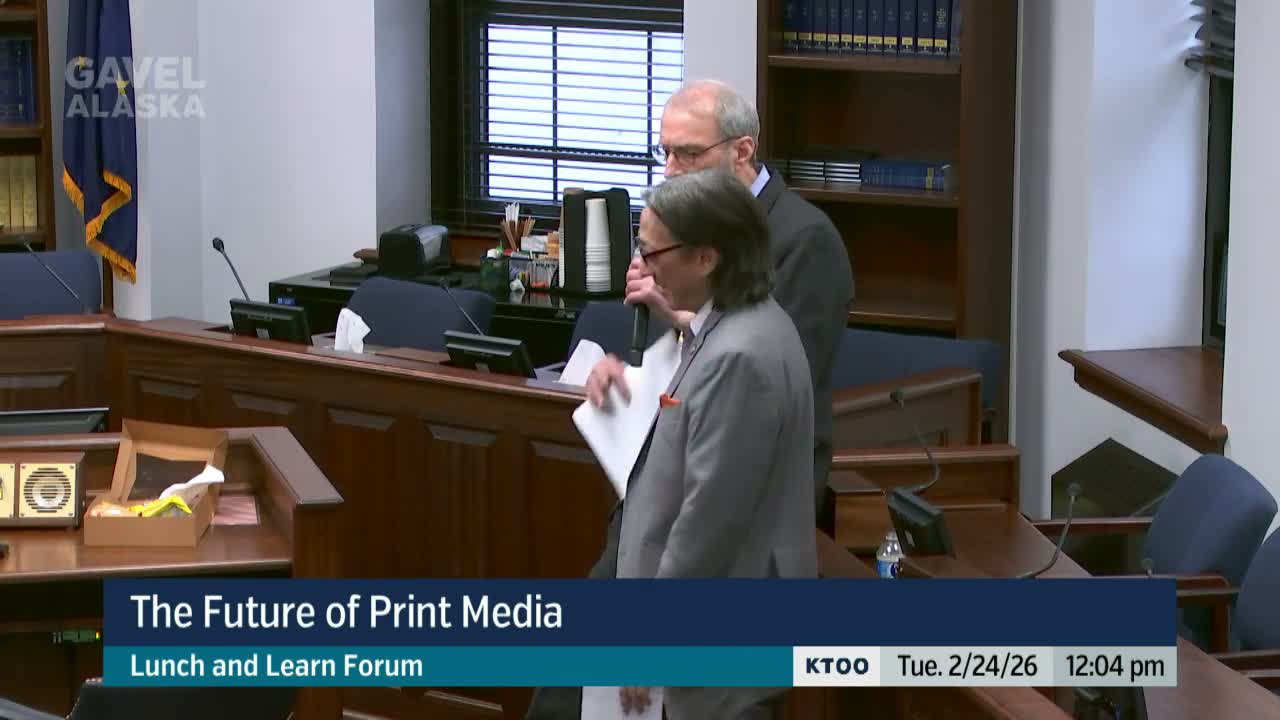
Summary
At a Juneau Lunch and Learn, Larry, chair of the Alaska News Coalition and owner of small Alaska weeklies, said print costs, lost advertising and shrinking newsrooms threaten local papers; the coalition has distributed seed grants, is building content-sharing and editor-support programs, and is seeking more funding.
Larry, chair of the Alaska News Coalition and owner of several small Alaska weeklies, told a packed Juneau "Lunch and Learn" that many of the state's local newspapers are on precarious financial footing and that the industry must change to survive.
"The definition of news is telling you something you don't know," Larry said, arguing that local outlets must offer distinct, locally rooted reporting to retain readers. He told attendees that the two largest costs for small papers are printing and payroll and described the logistical expense of printing in Alaska, where many towns lack nearby presses.
Using his own Wrangell paper as an example, Larry said the title lost about $30,000 last year and that the operation spends roughly $50,000 annually on out‑of‑town printing and air freight. "If we didn't pay for printing, air freight and postage, the paper would break even," he said, but he warned that dropping a print edition would likely reduce revenue because many subscribers are older and prefer print.
Larry described the Alaska News Coalition, formed in 2024 and organized as a nonprofit, as an effort to stabilize local news by pursuing grant-funded reporting and practical operational help. He said the coalition received $100,000 from a national funder, Press Forward, and raised roughly $50,000 from Alaskans. The coalition has used some funds to help southeast papers digitize websites and newsletters.
Two practical projects Larry highlighted are a shared content system to allow widely scattered papers to exchange coverage, photos and sports reporting at low cost, and a virtual pool of fill-in editors to support newsrooms that have lost editorial capacity. He said both efforts are intended to improve coverage without raising local newsrooms' fixed costs.
A major structural threat Larry raised is the loss of public‑notice revenue. He estimated that about $2,000,000 a year in Alaska goes to newspapers for public notices, and noted that some local governments — including the City of Soldotna and the Kenai Peninsula Borough — have passed ordinances allowing online notices, and the City and Borough of Juneau are discussing similar changes. "With $2,000,000 on the table, it's something we gotta deal with," he said.
Audience members pressed on related topics: recruitment and training of new journalists, whether broadcast suffers similar declines, perceived media bias, and whether philanthropy or wealthy benefactors can solve the industry’s problems. Larry said journalism schools still enroll students but that many prefer electronic media and that underpaid, quota‑driven staffing models produce low‑quality reporting. He suggested the coalition could help by providing temporary editorial support and training.
On technology, an attendee asked if AI could serve as a "force multiplier" to surface story ideas from public records; Larry said some outlets are experimenting but he personally would not use AI in his newsroom, though he acknowledged it might be useful for others.
Larry closed by urging reporters and publishers to focus on the community stories that only local outlets can cover — school board decisions, business openings and other neighborhood news — and said the coalition is seeking additional funders to scale its pilot projects. He said the group has limited funds remaining and hopes to find partners to expand grants, training and content‑sharing work.
The event concluded with applause; the coalition plans to continue grantmaking and development of the content‑sharing and editorial support programs while soliciting further funding.