Get AI Briefings, Transcripts & Alerts on Local & National Government Meetings — Forever.
DCCED director outlines revenue options and staffing gaps as lawmakers probe fee structure and actuarial needs
Loading...
Summary
Department of Commerce Director Hannah Lager told the House Finance DCCED subcommittee on Feb. 24 that the department contributes more than $100 million to the general fund, faces hiring challenges for technical positions and is seeking continued contractual actuarial support; lawmakers pressed for specific low‑hanging revenue options and timeline data for licensing transfers.
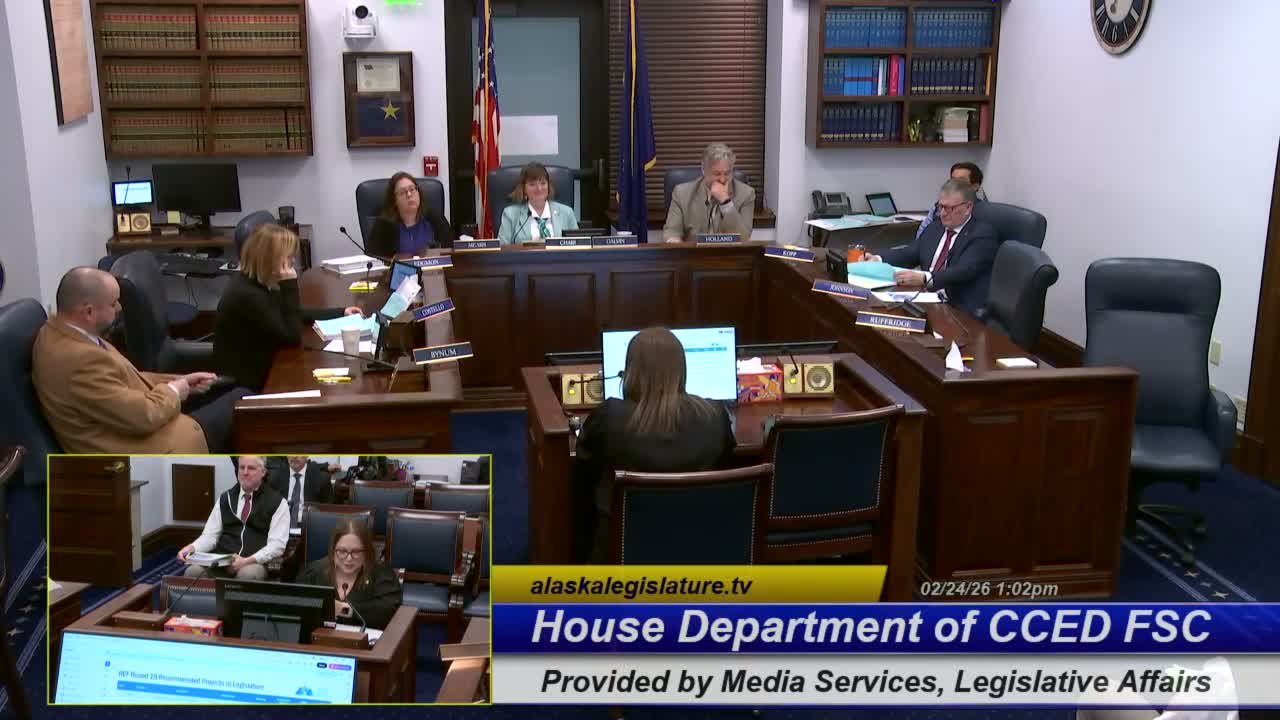
Hannah Lager, director of the Department of Commerce, Community, and Economic Development, answered subcommittee questions on Feb. 24 about revenue sources, fee structures and recruitment challenges for specialized positions.
"We do contribute well over a $100,000,000 to the general fund currently," Lager told the committee, pointing members to the department overview slides that break out major sources such as licensing receipts, fines and forfeitures. She said some licensing and fee areas are reviewed annually or biennially, while other fees have not been comprehensively reviewed on a set timetable.
Lager said the department is conscious that fee increases affect Alaskans and that many proposals are politically and administratively sensitive. On staffing, she described difficulty hiring and retaining specialized staff—such as investment officers and actuaries—and said the department has relied more on contractual actuaries because permanent hires are scarce and expensive:
"We're relying on those contractual actuaries more and more," Lager said, explaining a multi‑year $1,000,000 request for actuarial support to handle complex insurance filings and rate calculations.
Committee members pressed whether some recently requested increases (for the Division of Investments and the Alcohol and Marijuana Control Office) could be reduced; Lager said much of the apparent budget delta reflects underspending in FY25 and that FY27 requests are largely status‑quo with contractual salary and health adjustments. She agreed to provide the committee with written timelines and staffing metrics for alcohol license transfers and business licensing processing times.
Lawmakers and Lager also discussed recruitment feedback (competitive private‑sector pay, vacancy factors) and broader budget levers such as business licensing changes previously proposed by governors. Lager said the department will follow up with more detailed, program‑level information for the committee to consider during amendment deliberations.
Chair Galvin reminded members the subcommittee will reconvene on March 3 to act on governor amends and member amendments, and set an amendment deadline for Feb. 27 at 4 p.m.