Senate Finance hears DNR plan to renew in‑state royalty‑in‑kind oil contract for Kenai refinery
Loading...
Summary
DNR told the Senate Finance Committee a revised short-term royalty‑in‑kind contract would preserve supply for the Kenai/Marathon refinery, replace a floating differential with a fixed RIK differential, and must be approved by the legislature by April to meet nomination deadlines; the committee adopted a committee substitute and set the bill aside for future consideration.
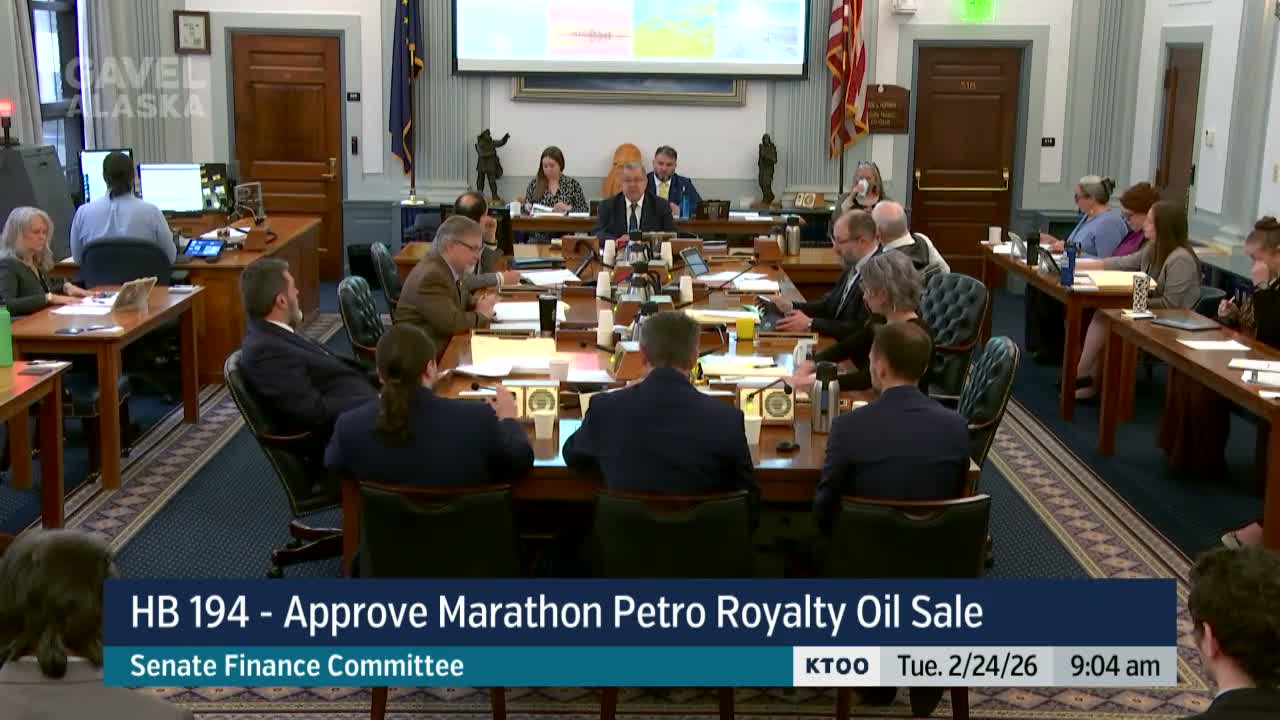
The Senate Finance Committee on Feb. 24 heard from the Department of Natural Resources on House Bill 194, a proposal that would authorize a renewed royalty‑in‑kind (RIK) oil contract to supply the Kenai refinery. Committee members adopted a committee substitute as the working document and then received a presentation from DNR explaining changes in contract timing and pricing.
DNR Commissioner Designee John Crother told the committee the substitute updates the contract to a shorter, “back to basics” term and a more standard pricing differential to keep in‑state refinery supply flowing. Weston Nash, a commercial analyst with DNR’s Division of Oil and Gas, outlined the RIK process, saying the state may take royalty in cash or in kind and that a final contract requires a best‑interest finding, Royalty Board review and legislative approval. “We extended the existing contract one extra year,” Nash said, explaining DNR had already used a one‑year extension and is seeking legislative approval for the new term.
Nash described the proposed Marathon contract as a 17‑month primary term with two optional one‑year extensions and volumes in the neighborhood of 5,000–10,000 barrels per day. He said the CS replaces a floating location‑differential mechanism with a fixed RIK differential derived from a published monthly average minus a small fixed amount (cited by staff as roughly $0.24–$0.26). According to Nash, the change is intended to produce a predictable premium for the state because the state’s flexible nominations better match refinery needs.
Committee members pressed DNR on refinery incentives, crude‑quality accounting and the timing for nominations. Nash warned that the current Marathon contract expires July 31, 2026, and that the state needs roughly 100 days’ lead time to nominate deliveries — a deadline that makes April 2026 the practical point by which an approved contract must be in place. He said DNR expects incremental revenue of roughly $4–$6 million above royalty and value and noted jobs tied to refinery operations.
Casey Sullivan, who identified himself as government and public affairs manager for the Kenai refinery, testified online in support of the CS, calling the negotiations with DNR constructive and saying the revised contract provides “availability, flexibility and stability for the refinery and the state.” Senator Keel reviewed a fiscal note from DNR’s Division of Oil and Gas that showed no added costs and an indeterminate change in revenues for fiscal years 2028–2030, with materials in the packet noting potential state revenue between $12 million and $18 million across those years.
With no further committee action today, the committee set HB 194 aside for future consideration. The chair said the committee will return to the item at a later date to allow additional review.