
San Luis Obispo council directs staff to develop rental-registry work plan after study session
Get AI-powered insights, summaries, and transcripts
Subscribe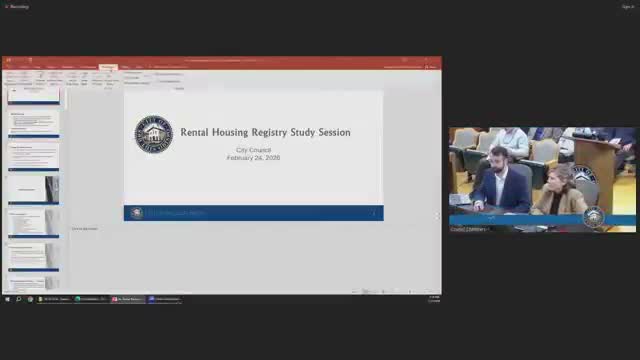
Summary
After a lengthy study session and nearly two hours of public comment, the City Council asked staff to craft a detailed work plan to include a rental housing registry in the next financial plan, while staff will continue targeted research, outreach and cost analysis.
San Luis Obispo Mayor Erica A. Stewart convened a special study session where City staff presented options for a rental housing registry and councilmembers questioned costs, data quality, legal limits and enforcement before directing staff to prepare a work plan for the next financial plan.
The Community Development director, Timmy Tway, and senior planner David Amini framed the session as informational and said the registry discussion is part of the city’s housing and neighborhood-livability work plan. Amini summarized outreach findings and baseline statistics: "59% of households in the city are renters," he told the council, and staff estimates between "12,000 to 14,000 estimated rental units in the city." Staff presented three implementation options: expand the city’s business-license records; a voluntary vendor-run registry; or a mandatory, software-based registry implemented by ordinance with a phased rollout and enforcement period.
Why it matters: Councilmembers and public speakers said better unit-level data matters for multiple city responsibilities — shaping the housing element, targeting code enforcement and informing renter-protection policy. Supporters, including tenant groups and student representatives, said a mandatory registry would produce timely, complete data and help identify unsafe housing and absentee owners. Opponents, including many local realtors and property managers, warned of costs, privacy risks, duplicate reporting and the possibility that fees or compliance costs could be passed to tenants.
What staff presented: Vendors and jurisdictions staff consulted suggested off-the-shelf registry platforms that can identify properties (assessor data, web scraping), host owner portals, offer tenant logins and generate reports. Staff described practical trade-offs: voluntary registries often reach a low share of units (staff cited vendor estimates around 20% in a first year), while mandatory programs require more staff (staff estimated roughly 3 full-time equivalents across housing, code enforcement and the city attorney’s office) and multi-year outreach and enforcement to reach high compliance. Staff also flagged legal and policy limits: they noted the Costa-Hawkins constraints on local rent stabilization (units built after 1995 and single-family homes are generally exempt).
Council debate and public comment: Councilmembers pressed staff on vendor pricing, what fields would be verifiable, how the city would protect private data and whether existing business-license systems could be adapted. Finance and code-enforcement staff described the city’s current business-license fines and how enforcement typically works. Public comment ran more than 90 minutes and featured sharply divided views: tenants, student representatives and housing-justice groups urged a mandatory registry plus a health-and-safety checklist and ties to code enforcement; many property managers, realtors and some landlords urged a pause, asked for clearer problem definitions and recommended lower-cost alternatives or upgrades to existing datasets. "A rental registry at its core is about information," Monterey Mayor Tyler Williamson told the council, urging the city to be intentional about data structure and outreach based on Monterey’s multi-year rollout experience.
Council direction and next steps: After deliberation, the council asked staff to continue targeted research and stakeholder outreach and to return with a detailed work plan and cost estimates for inclusion in the next financial plan. City staff agreed to gather more vendor and peer-city details, refine staffing needs and scope, consult legal and IT on privacy protections, and identify interim items that could be advanced without significant new staffing. The City Manager summarized the direction as moving the project forward for consideration in the upcoming budgeting cycle and continuing preparatory research and outreach in the months ahead.
What’s next: Staff will return with a proposed scope, timing and budget recommendation so the council can weigh trade-offs (timing, fees, exemptions for small owners, public-facing data, enforcement staging). The council will also continue scheduled code-enforcement and housing-element work sessions that staff say will inform final program design.