Get Full Government Meeting Transcripts, Videos, & Alerts Forever!
Get email alerts on the Legislation Votes topic
No spam. Unsubscribe anytime.
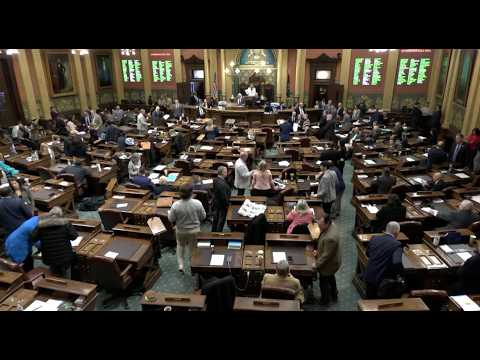
Michigan House approves multiple bills on taxes, public health and appropriations; immediate effect ordered for many
Summary
The Michigan House passed a series of bills on Feb. 24, 2026, including measures affecting the income tax act, the public health code and multiple appropriations bills. Roll-call tallies were read for each bill and several were ordered to take immediate effect.
The Michigan House of Representatives on Feb. 24, 2026, approved a slate of bills that lawmakers said amend state tax law, the public health code and multiple appropriations measures.
House Bill 5517, described by the clerk as a bill to amend the Income Tax Act of 1967, advanced through second and third readings with no amendments. The clerk recorded "94 aye votes and 12 nay votes," and the House declared the bill passed. The majority floor leader then moved for immediate effect, which the House ordered.
Three bills amending the public health code — House Bill 4593 (calendar item 19), House Bill 4594 (calendar item 16) and House Bill 5102 (calendar item 20) — were each read for a third time and put to roll-call votes. The clerk announced "105 aye votes and 1 nay" for HB 4593, "105 aye votes and 1 [nay]" for HB 4594, and "106 aye votes and 0 nay votes" for HB 5102; each bill was declared passed and immediate effect was ordered.
Additional bills passed included a measure amending the occupational code (clerk tally reported "105 aye votes and 1 [nay]") and several other measures, including bills amending the Lawful Internet Gaming Act and the Horse Racing Law of 1995. The clerk announced an unclear tally language for House Bill 4346 (transcript line reads: "I votes of 18 nay votes") but the transcript records the bill as passed; House Bill 4347 was recorded as passing with "86 aye votes and 20 nay votes." Where the transcript’s tally wording was unclear, the article reports the clerk’s exact phrasing rather than inferring counts.
Several members moved for immediate effect on bills that passed, and the motions were ordered orally on the floor.
What’s next: The House’s calendar and the clerk’s announcements included numerous new bills referred to committees (appropriations, regulatory reform, government operations, and others). Committee hearings and appropriations subcommittee meetings were scheduled for early March, according to the clerk’s notices.
Vote counts and formal outcomes reported on the House floor are described above using the clerk’s announcements as read into the record; where the transcript contains unclear or partially garbled language the transcript phrasing is quoted or noted rather than paraphrased.