
Taos Municipal Schools board holds workshop on strategic plan, moves to pursue CES assistance
Get AI-powered insights, summaries, and transcripts
Subscribe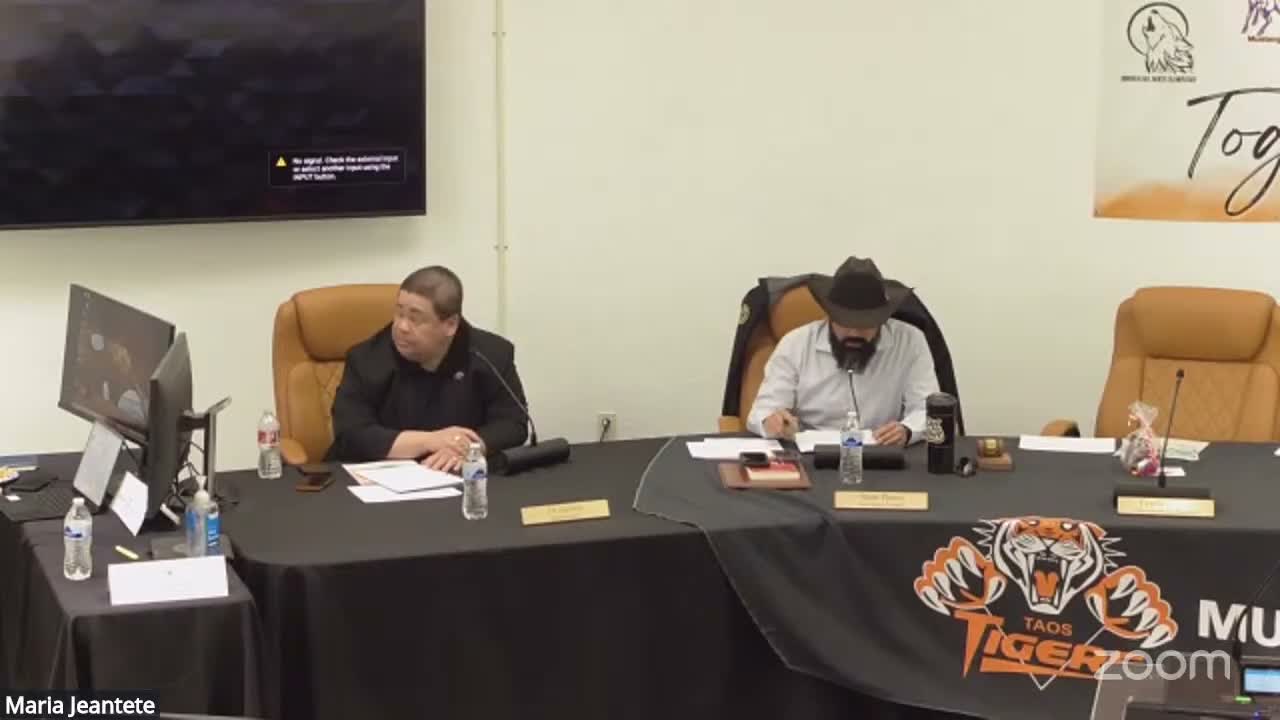
Summary
At a Feb. 20 work session, Taos Municipal Schools trustees reviewed vision, mission and core values, heard a student‑outcomes governance presentation, and agreed to pursue complimentary strategic‑planning support from CES while preserving the option to issue an RFP.
Taos Municipal Schools President Flores opened a special board work session Feb. 20, 2026, to focus on updating the district’s strategic plan and adopting a student‑outcomes focused governance model.
The board invited David Chavez, executive director of CES, and CES coaches Lillie Mae Ortiz and Yolanda Cordova to lead the session. Chavez told trustees the district’s current strategic plan — developed in 2022 and adopted around 2023 — runs through 2026 and will need revising or replacement. He highlighted recent district accomplishments, including higher attendance, library program revisions and passage of a $50,000,000 general obligation bond to support construction of a middle school.
"You'll need to either redo the plan that you currently have or come up with a new plan altogether," Chavez said, outlining a process that begins with clarifying vision, mission and core values and proceeds through goal‑setting and progress monitoring.
CES coach Lillie Mae Ortiz framed the governance approach around five pillars: clarifying mindset, priorities, monitoring progress, aligning resources and communicating results. She emphasized that boards should set the "what" and let superintendents determine the "how," and recommended boards define a small set of SMART goals and measurable guardrails that specify actions the superintendent should not take.
"Boards govern and the superintendent manages," Ortiz said. "The board sets the what, adopts the goals, the vision and the guardrails." She and Chavez recommended that boards aim to spend at least 50% of regular meeting time on student outcomes and instruction-focused monitoring, presented through short‑cycle assessment data and a compact KPI (key performance indicator) scoreboard.
Trustees spent time in small groups drafting concise core values and vision statements. Group proposals emphasized themes such as excellence, equity, innovation, accountability and community connection; examples offered to the board included the vision "Empower the creation of a transformative culture that inspires innovative learning" and a draft mission emphasizing preparation academically, socially, emotionally and physically for success in college, career and life.
Chavez outlined a recommended community needs assessment to inform goals: identify key stakeholder groups (he suggested eight), invite roughly 10 members of each group to a facilitated session, and prioritize needs through peer and stratified exercises; that process, he said, typically takes two to four months to complete and yields a report districts can use for goal setting.
On procurement, Chavez told the board that because Taos is part of a CES six‑year study the agency can provide strategic‑planning support at no cost to the district. Several trustees said they were comfortable proceeding with CES while retaining the option to issue an RFP for additional proposals. Superintendent Antonio Layton said an RFP could still be published but recommended that any solicitation include the student‑outcomes governance framework as part of its scope.
No binding contract was approved at the session; board members asked staff to work with CES to develop a timeline and next steps and said they would invite any absent trustees into the process. President Flores announced the next regular board meeting, scheduled for Feb. 25, 2026 at 6 p.m., and the board adjourned the work session.
What happens next: the board directed staff to move forward with planning steps that include documenting the small‑group outputs and working with CES and the superintendent to propose a calendar, community needs assessment schedule and a draft approach to goals, guardrails and KPI monitoring for trustee review.