
Committee approves competing public‑defense bills after agreeing consent and payment language
Get AI-powered insights, summaries, and transcripts
Subscribe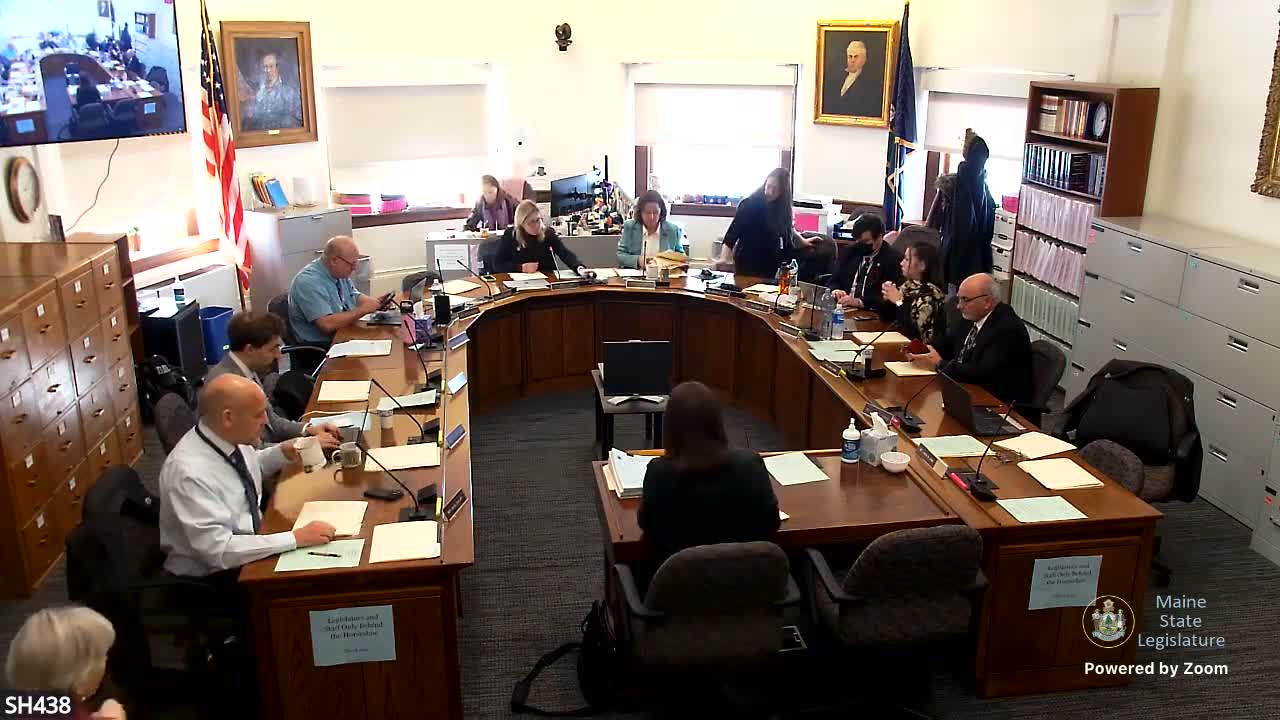
Summary
Lawmakers advanced LD 21‑93 and LD 21‑95 with amendments to clarify when private attorneys must consent to court appointments and when the Maine Commission on Public Defense Services must compensate them. The committee accepted 'consent in advance' language and clarified payment responsibility; both bills moved forward with unanimous support of members present.
The joint Judiciary committee considered two related bills, LD 21‑93 and LD 21‑95, that respond to last session’s emergency arrangements for court‑appointed private attorneys and who pays them.
LD 21‑93 would reenact and extend earlier temporary law (enacted as part of last year’s LD 1101 / Public Law 2025, ch. 40) that required PDS (the Maine Commission on Public Defense Services) to reimburse private attorneys appointed by courts under certain circumstances. LD 21‑95 reflects the PDS recommendation: it would prohibit a court from appointing or assigning a private attorney to represent an indigent person unless (1) the attorney consents in advance and (2) PDS has determined the attorney is eligible.
Committee members and witnesses negotiated several technical changes and clarifications. The Judicial Branch supported inserting 'consent in advance' and suggested extending the sunset date; PDS proposed clarifying compensation rules (PDS may decline reimbursement consistent with assigned‑counsel rules, one reimbursable private attorney per docket number, and compensation parity with assigned counsel) and asked that payment rules focus on when PDS must pay rather than directly curtail court appointment authority.
Julie Finn (Judicial Branch) said the branch was willing to accept the in‑advance consent language and offered 04/01/2027 as an acceptable compromise sunset date. Frayla Tarpenian (PDS) said PDS would prefer letting the prior authority (18‑07) sunset but could tolerate a short reenactment if necessary to address short‑term constitutional or operational pressures; PDS emphasized its preference to manage rostering, training and payment through its ordinary processes.
Representative Sinclair moved that LD 21‑95 'ought to pass as amended' with language that emphasizes payment responsibility (so PDS does not pay for appointments made contrary to the statutory scheme); Representative Sato seconded. The committee voted 10‑0 with 4 members absent and closed LD 21‑95 as recommended.
The committee then voted 10‑0 (4 absent) to advance LD 21‑93 as amended (salmon amendment with 'consent in advance' language and payment clarifications). Both work session recommendations passed unanimously among members present.
Next steps: staff will draft the agreed technical language, the fiscal‑note process will estimate any appropriation needed to cover reimbursement obligations, and committee staff will circulate revised language to the Judicial Branch and PDS for sign‑off before finalizing.