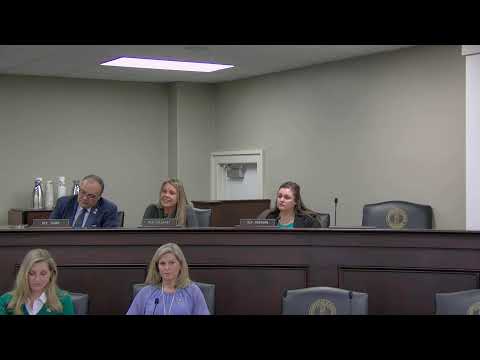
House committee backs feasibility study for locally run Medicaid 'accountable community' pilot

House Standing Committee on Health Services · February 26, 2026

Get AI-powered insights, summaries, and transcripts

Subscribe
AI-Generated Content: All content on this page was generated by AI to highlight key points from the meeting. For complete details and context, we recommend watching the full video. so we can fix them.

Summary

The House Standing Committee on Health Services unanimously approved Senate Concurrent Resolution 9, which asks for a feasibility study of a locally owned, public–private 'accountable community health care organization' pilot intended to reduce Medicaid spending through local accountability and prevention.

The House Standing Committee on Health Services voted unanimously to approve Senate Concurrent Resolution 9, a nonbinding resolution asking for a feasibility study into a locally owned, not-for-profit “accountable community health care organization” as an alternative delivery model for the Medicaid program.

Senator Steve Meredith (senator, chair of the Senate Standing Committee on Health Services), who introduced the resolution, told the committee he considers the state and national trajectory of health-care spending unsustainable and urged a new model that shifts risk and decision-making to local providers and communities. “We do have to do something different,” Meredith said, arguing that managed care organizations’ administrative costs and profit incentives reduce money available for care.

Meredith cited state-level Medicaid figures and national comparisons as part of his case: he said per-capita U.S. health-care spending is roughly $15,000 and noted Kentucky’s Medicaid budget growth since 2017 (from about $10 billion then to more than $20 billion now). He said Medicaid enrollment rose from about 920,000 to about 1.4 million since 2010 and estimated administrative overhead and investment returns by MCOs as areas for redirection; he characterized the pilot as a five-year, locally focused feasibility study covering three area development districts and roughly 125,000 Medicaid recipients in those regions.

Committee members asked detailed questions about how the model would differ from current managed care operations and about likely administrative costs. Ranking Member Wilner asked how the proposal would remove barriers between patients and providers; Meredith replied the model would use capitated payments that place providers and communities at financial risk and would eliminate some preauthorization and administrative middlemen. Representative Fleming asked whether the committee or sponsors had cost estimates to administer the model; Meredith said that is the purpose of the feasibility study and suggested grant funding (for example, a rural health transition grant) could help offset start-up costs.

Meredith described the proposal’s aspirational outcomes as a long-term reduction in Medicaid expenditures (he framed a “20 by 30” goal to reduce Medicaid spending 20–30 percent by 2030) and suggested data-sharing and incentive mechanisms that would allow savings to be redirected locally and, in some cases, shared with individuals as benefits.

The committee took a roll call voice vote; several members explicitly responded “Yes” or “Aye” during the tally and Chair Mosher announced the resolution “passes with unanimous expression.” The resolution is nonbinding and, per the chair, is intended to proceed to the House floor for further action.

The committee’s discussion made a distinction between the resolution’s feasibility-study request and any immediate change to eligibility or benefits: speakers repeatedly framed the resolution as a study and planning step, not as a legislative change to Medicaid coverage.

What happens next: The resolution will be carried forward to the floor as the committee recommended; the feasibility study and any subsequent pilot would require future legislative or administrative action and funding.