
Kentucky House votes to opt state into federal education scholarship tax-credit program amid sharp debate
Get AI-powered insights, summaries, and transcripts
Subscribe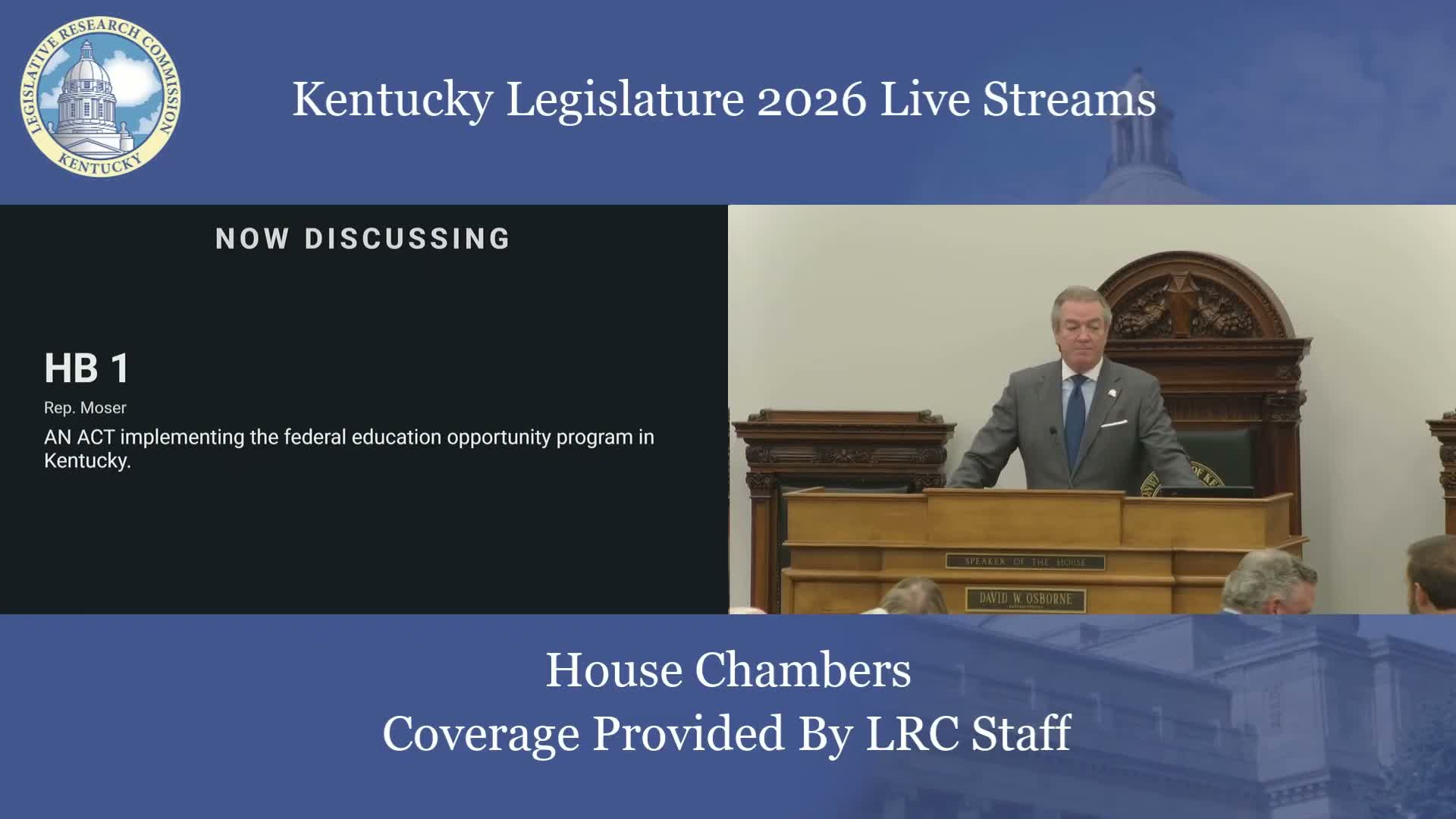
Summary
The Kentucky House passed House Bill 1 to opt the Commonwealth into the federal education scholarship tax-credit program (HR 1), adopting a committee substitute and rejecting motions to table and to suspend rules for a floor amendment. Supporters said the measure brings private donations to Kentucky students without using state general funds; opponents called it a backdoor voucher and said it lacks oversight and risks shifting federal funding away from public schools.
The Kentucky House on the floor passed House Bill 1, authorizing the Commonwealth to opt into the federal education “scholarship tax credit” program established by HR 1, after adopting House committee substitute 1. The clerk recorded the final passage with 79 members voting in favor and 17 opposed.
Sponsor the lady from Kenton (District 64) told members the measure simply allows Kentucky to opt into a federal tax-credit scholarship program and “ensures that no general funds, no Kentucky taxpayer dollars are used to administer the program.” She said the program authorizes scholarship-granting organizations (SGOs) to collect private donations and distribute dollars for K–12 expenses such as tutoring, technology, transportation and special-needs services and reiterated that the opt-in would keep donation dollars in Kentucky rather than flowing to other states.
Supporters framed the choice as keeping federal tax-credit dollars in-state. The gentleman from Boone (District 66) said, “Do you want this federal tax cut to benefit Kentucky students, or do you want this federal tax cut to benefit non-Kentucky students? Personally, I choose Kentucky.” Proponents argued the federal law requires state certification of SGOs and cited Espinosa v. Montana Department of Revenue and federal tax provisions in defending the constitutionality of the approach.
Opponents raised process and policy objections. The lady from Jefferson (District 34) moved to table the bill on process grounds—saying the measure was filed and substituted too recently and that members and the public lacked adequate time to review the committee substitute; that motion failed to reach the constitutional majority required. The lady from Fayette (District 93) argued the policy is “a subsidy for the wealthiest dressed up as educational opportunity,” warned of private schools that are not bound by the same civil-rights and access requirements as public schools, and criticized the absence of academic-performance reporting and robust transparency provisions in the bill. The sponsor said SGOs set parameters for scholarships and that the federal statute constrains allowable uses.
A floor amendment (floor amendment 6) that would have required collection and reporting of recipient counts, household income and demographic information was proposed by the lady from Jefferson (District 38). She moved to suspend rules to consider the amendment; the motion to suspend rules failed to reach the 51-vote constitutional threshold and the amendment was not considered on the floor.
Members offered short explanations for their votes on final passage. The clerk recorded 79 yeas and 17 nays; the record shows one abstention noted during the roll. The House passed House Bill 1 as amended by House committee substitute 1. The transcript does not record subsequent action in the Senate or any enacted effective date in this session record.