Get Full Government Meeting Transcripts, Videos, & Alerts Forever!
Get email alerts on the Economic Development topic
No spam. Unsubscribe anytime.
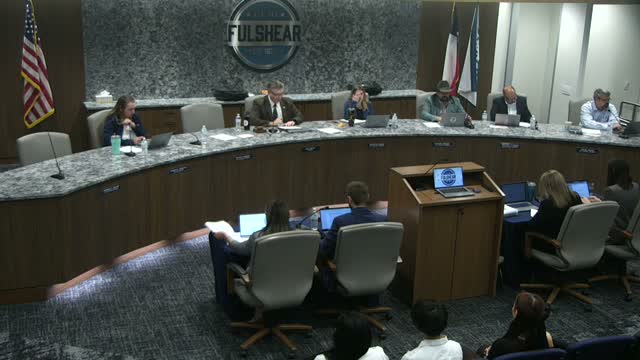
Fulshear council hears EDCA warning: cutting sales-tax rebates could stall downtown projects
Summary
EDCA president Brian White told the council that reducing the EDCA A boards sales-tax allocation to fund police pay would shrink a roughly $6 million fund and could delay or block downtown drainage and parking projects, which he said are prerequisites for commercial development.
Brian White, president of the EDCA board, told the Fulshear City Council that proposals to reallocate EDCAs sales-tax allocation to other uses would reduce the corporations ability to fund infrastructure projects that currently block downtown commercial development.
White said the EDCA fund balance is "roughly $6,000,000" today and that projected allocations and commitments mean the balance will decline over time; under some scenarios he warned the fund could approach zero. He singled out two projects in the council packetthe West Side Streets/Westside Detention project and the Wall Street (downtown) road projectand said multiple downtown parcels cannot be developed until drainage and parking needs are addressed. "Multiple properties in the downtown district cannot be developed until these drainage projects are done," he said.
Council members pressed White and staff for numbers. A councilmember asked for projected job counts and anticipated tax revenue from the properties; White said he did not have specific estimates on hand and that the packetincluding an Excel sheet and a projects listwould be updated to show allocations. Staff told the council that the packet chart reflects prior investments and pending requests but that EDCA has not committed funds for the FY '26–'30 items shown.
White offered illustrative costs for major projects under discussion: a parking garage ($10 million to $25 million), drainage projects ($5 million to $10 million), and an underpass option (~$10 million). He said those examples add to roughly $35 million in identified needs and stressed that EDCA alone cannot fully fund major projects.
Council members asked how EDCA could pay for larger projects if its sales-tax allocation were reduced by a quarter cent; staff and finance advisers said EDCA could pursue revenue bonds but that any bond proposal would require a detailed financial model showing payback. The Wall Street project was discussed specifically: staff said the county mobility bond funds the base Wall Street project and that the city's cost is capped by an interlocal agreement (ILA) at $2.6 million payable over seven years (about $371,000 annually), while city enhancements beyond the base project would be a city cost.
White cautioned that some development agreements include sales-tax rebates that can reduce city receipts for up to a decade. He also said the EDCA board had not expected its funding stream to be cut in the manner proposed and that legal and contract details remain to be evaluated.
What happens next: council members asked staff and EDCA to return with clearer, itemized financial impacts, including projected tax revenue, job estimates, a fund-balance schedule and legal implications for existing rebate agreements. No formal change to EDCA collections was made during the meeting.