Lifetime Citizen Portal Access — AI Briefings, Alerts & Unlimited Follows
OHA trustees approve staff positions across matrices and request rapid-response role on Banyan Drive measure
Loading...
Summary
The Office of Hawaiian Affairs Board of Trustees on Feb. 25 approved staff bill-position recommendations across multiple matrices and asked advocacy staff to submit rapid-response testimony asking that OHA be consulted — and have a voting seat — on amendments to a Banyan Drive provision now placed inside a stadium authority bill.
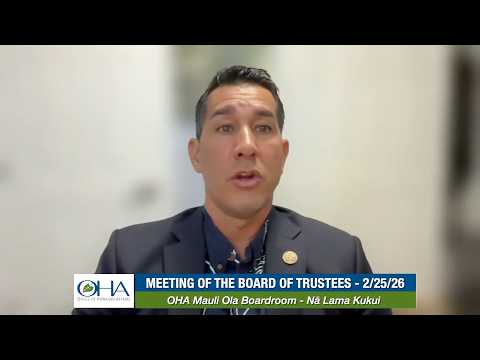
The Office of Hawaiian Affairs Board of Trustees voted Feb. 25 to accept staff recommendations on a slate of legislative bills and directed quick action on a late change to a Banyan Drive measure now contained in a stadium authority bill.
Deja Ostrowski, advocacy manager for OHA, told trustees that language from SB2616 relating to Banyan Drive was gutted and replaced and folded into a stadium authority bill. "We submitted rapid-response testimony asking that OHA have a seat at the table, because of the ceded and government lands that are a part of Banyan Drive," Ostrowski said, summarizing testimony that asks that the lineal-descendant representative remain a voting member rather than only a consultative seat.
Why it matters: Trustees said the change required a quick response because bills can be amended and moved across vehicles during final committee activity. The board waived the usual Beneficiary Advocacy & Empowerment (BAE) committee review to allow a prompt board-level position and then approved staff recommendations across multiple matrices that set OHA's formal posture for the legislative session.
Board action and votes: After waiving BAE consideration, trustees approved the staff position recommendations for the published matrices with specified exceptions. Key recorded outcomes included:
- Waiver to bring committee items directly to the board: motion carried (7 yes votes). - Matrix 2 (public land trust related bills, except downgrading HB1917 to comment, and supporting PLT bills with amendments): approved (8 yes votes). - Matrix 3 (public land trust housekeeping changes, SB2169, SB2596): approved (8 yes votes). - Matrix 4 (natural resources and Mauna Kea-related items; SB2046 moved from support to comment; Mauna Kea matters noted for transfer to Matrix 3): approved (9 yes votes). - Matrix 5 (native Hawaiian housing; a change to move HB1738/SB2007 from monitor to comment): approved (8 yes, 1 abstention). - Matrix 6 (native Hawaiian health): approved as published (9 yes votes). - Matrix 7 (native Hawaiian education): approved as published. - Matrix 8 (economic stability; staff flagged a $5,000,000 geothermal appropriation embedded in DHHL-related transient-accommodation-tax language and recommended moving HB2114 — a proposed Hawaii Benefits Hub — from support to monitor): approved with exceptions (9 yes votes). - Matrix 9 (kupuna and historic preservation): approved as published (9 yes votes).
Staff rationale and concerns: Ostrowski said certain items required position changes because committee amendments or new bill text altered scope since publication of the matrices. On public land trust bills, she recommended "support with amendments" to preserve OHA influence over membership and revenue share. Trustee Emerita argued that an amendment creating an 8-to-4 split favoring state appointees over OHA could render the working group "unbalanced" and urged reworking that membership language.
On other bills, advocacy staff recommended letting subject-matter agencies lead. For example, SB2169 (Agribusiness Development Corporation) raised concerns about eminent-domain authority; staff recommended downgrading OHA involvement and deferring core technical comments to the Department of Land and Natural Resources. On SB2596 (government leases), staff recommended limited engagement because the measure addresses leases between state entities.
Trustee preparations for hearings: Trustees asked advocacy staff to provide hearing logistics and talking points and to introduce trustees when they accompany staff to testify, so legislators recognize OHA's presence. "When the trustees accompany our staff to the legislature to testify, our staff must introduce our trustees," Emerita said, requesting a standard operating procedure for introductions and a short script for those appearances.
Next steps: Advocacy staff will circulate the rapid-response testimony and final matrix materials to trustees and communicate committee hearing times so trustees can plan in-person attendance when possible.
Votes at a glance: All actions above reflect motions and roll-call votes recorded in the public portion of the Feb. 25 meeting; where the transcript recorded tallies, they are reflected above. The board also moved into executive session later in the meeting (see separate article).