Get Full Government Meeting Transcripts, Videos, & Alerts Forever!
Get email alerts on the Human Relations Commission topic
No spam. Unsubscribe anytime.
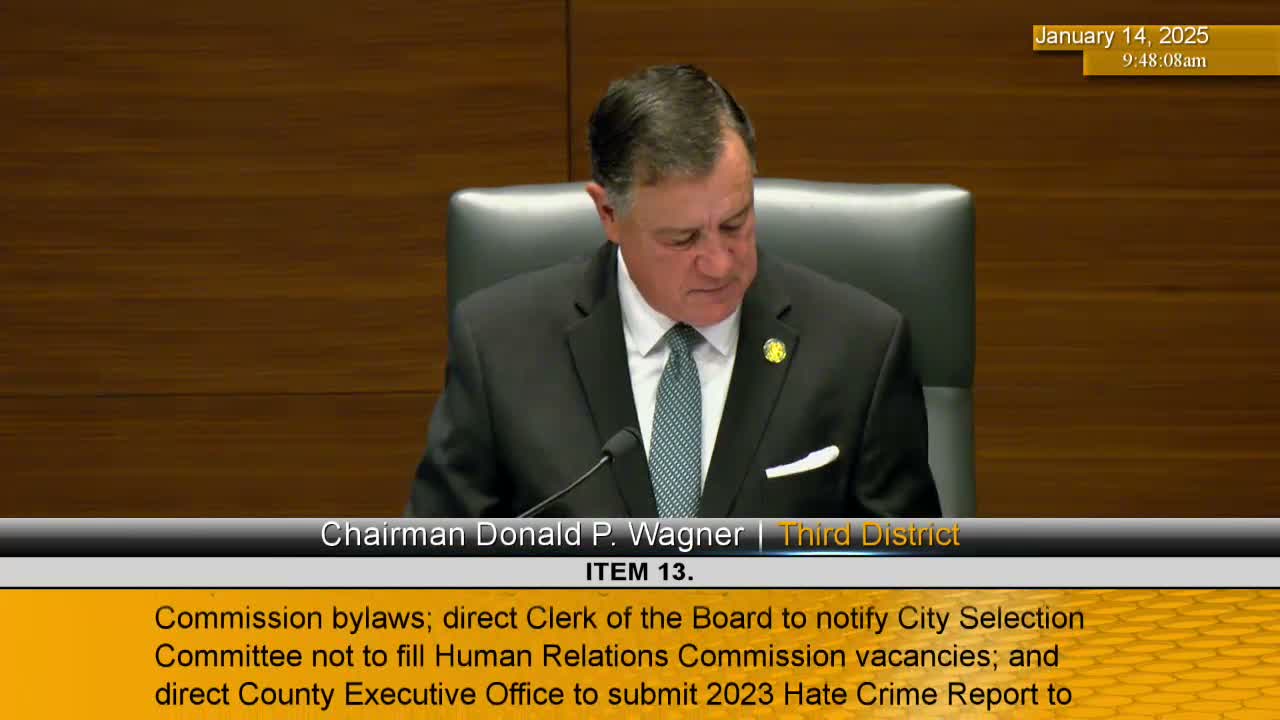
Board amends Human Relations Commission bylaws after heated debate over law‑enforcement seats
Summary
After hours of testimony from law enforcement, the District Attorney and community advocates, the Orange County Board of Supervisors voted 3–2 to amend Human Relations Commission bylaws to add law‑enforcement representation and to direct staff to improve hate‑incident data methodology.
Chairman Wagner opened a lengthy discussion about proposed changes to the Orange County Human Relations Commission on Jan. 14, saying the board asked staff to “reset” the commission’s structure and reporting. Sheriff Don Barnes and Irvine Police Chief Michael Kent urged keeping a law‑enforcement voice on the panel so the commission could receive direct operational context about hate crimes and trends.
Chief Michael Kent, speaking as acting president of the Orange County Chiefs of Police and Sheriffs Association, told the board the commission’s mission “is to combat hate in Orange County” and that law enforcement’s perspective “validates the importance of having us be part of the formula in combating hate in our communities.” District Attorney Todd Spitzer said his office would not serve on the commission but supported adding a chief position and stressed the need to develop standards for tracking hate incidents.
Staff explained the primary technical concern: inconsistencies in how the prior contractor collected and deduplicated incident reports. Jessica Witt, director of government community relations in the county executive office, said the county published the 2023 hate‑crimes report after inheriting midstream data and that staff lacked confidence in the contractor’s methodology. Deputy District Attorney William Haw, who prosecutes hate crimes, described the legal distinction between a prosecutable hate crime and a noncriminal “hate incident,” noting the Attorney General’s reporting forms capture referrals and filings differently.
Supervisors voiced divergent views about two linked questions: how large and independent the commission should be, and whether to restore law‑enforcement seats. Supervisor Vicente Sarmiento and others pressed to preserve a larger, 11‑member body to ensure broad community representation and to avoid chilling effects on survivors who might hesitate to speak before police. Supervisor Katrina Foley and Chairman Wagner defended a smaller reconstituted commission focused on fixing data collection and producing an overdue 2024 hate‑crimes report.
The board considered and approved an amendment to the staff recommendation that added law‑enforcement representation — one sheriff’s department seat and one rotating local police agency seat chosen by the Chiefs Association — while retaining a plan to revisit commission size during the budget and implementation process. The motion passed by voice vote 3–2. The board instructed staff and the proposed commission to develop a clear, county‑wide methodology for distinguishing and counting hate incidents and to coordinate with the District Attorney’s DOJ‑funded outreach and training program.
What happens next: staff will bring back details on implementation, an agreed‑upon methodology for hate‑incident reporting, and a recommended schedule to reconsider commission membership and outreach budgets.