Get Full Government Meeting Transcripts, Videos, & Alerts Forever!
Get email alerts on the Battery Storage topic
No spam. Unsubscribe anytime.
Orange County imposes 90‑day moratorium on new large‑scale battery energy storage projects
Summary
The Board adopted an uncodified urgency ordinance placing a 90‑day moratorium on permitting large‑scale battery energy storage systems in unincorporated Orange County so staff and OCFA can draft siting and safety regulations; public testimony included both safety concerns and industry calls for stronger state coordination.
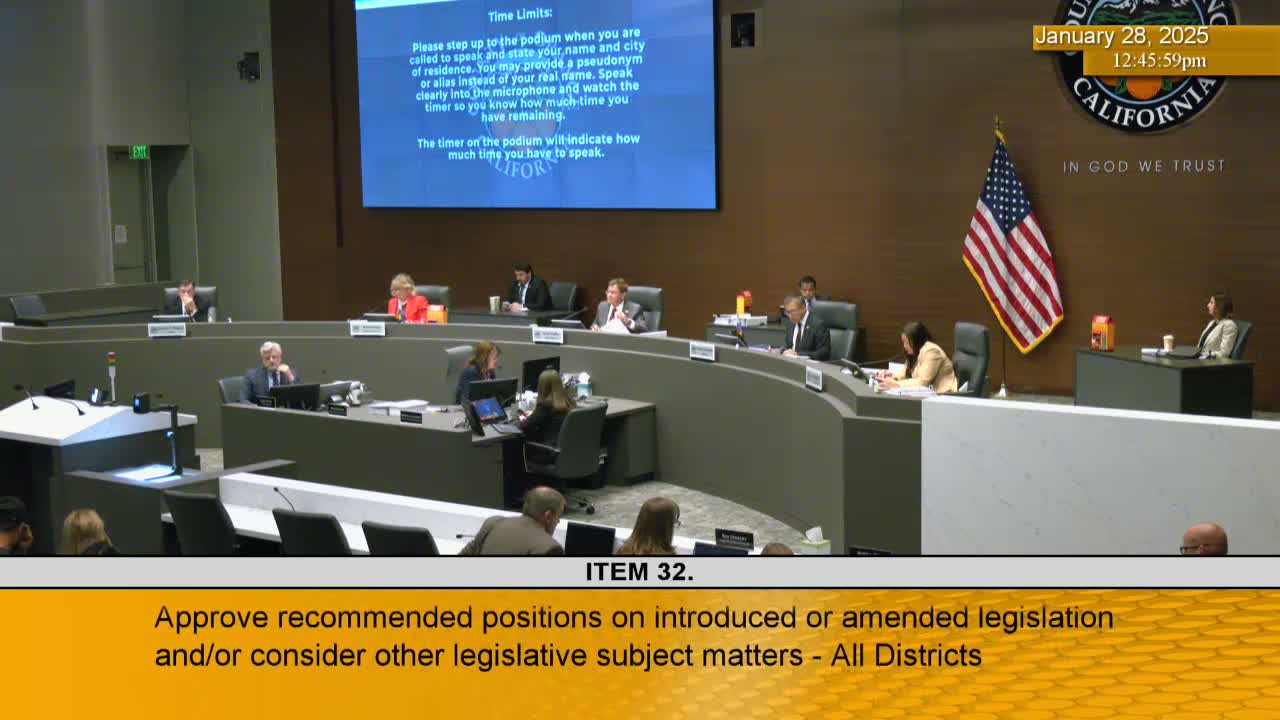
The Orange County Board of Supervisors on Jan. 28 approved an uncodified urgency ordinance temporarily halting new large‑scale battery energy storage system (BES) projects in unincorporated county areas for 90 days while the county and the Orange County Fire Authority develop safety and siting regulations.
Vice Chair Katrina Foley introduced the supplemental item, saying the county currently lacks zoning rules and safety standards tailored to large‑scale BES projects and that a temporary halt is needed to allow OC Public Works and OCFA to draft appropriate regulations. "We don't have any zoning. We don't have regulations," Foley said, and described recent local ignitions and regional fire risk as motivating factors.
Public comment was divided. Advocates and neighborhood groups urged a pause, citing risks of thermal runaway, fire‑fighting complexity and potential toxic runoff. "We do not want a Moss Landing disaster," said Kathleen Pryor representing a local group opposing neighborhood siting.
Industry and utility representatives including the Orange County Power Authority, N.G. North America and San Diego Gas & Electric described technological improvements (for example, lithium‑iron‑phosphate chemistries) and ongoing collaborations with fire authorities and regulators to improve safety. An NG representative said proposed projects (such as Compass in San Juan Capistrano) will use LFP batteries and site design intended to meet safety standards. SDG&E emphasized investments in wildfire mitigation and coordination with firefighters.
County counsel and staff said the board may adopt a moratorium under Government Code §65858 to protect public health and safety while regulations are developed; planning staff said developers had submitted inquiries (not formal applications) and that about 15 large‑scale storage facilities existed in the county as of mid‑year data referenced by staff. The moratorium would not apply to projects within city boundaries or state‑permitted projects already before the California Energy Commission.
The board voted to adopt the uncodified urgency ordinance (90‑day moratorium) and directed staff to work with OCFA, utilities and industry to draft regulations and a zoning approach; the motion carried unanimously.
What’s next: Staff will return with proposed regulatory language, zoning definitions (including thresholds to distinguish residential from large‑scale systems) and responses to safety and environmental concerns.