Get Full Government Meeting Transcripts, Videos, & Alerts Forever!
Get email alerts on the Homelessness topic
No spam. Unsubscribe anytime.
Board receives small‑scale housing report after emotional public comments calling for a housing bond
Summary
Following extended public comment listing unhoused residents who died, the Board received and filed the Commission to End Homelessness small‑scale housing report and directed the Office of Care Coordination to use it as a framework for recommendations and programs.
After an extended public comment period in which advocates and formerly unhoused residents read dozens of names of people who died while unhoused, the Orange County Board of Supervisors on Jan. 28 voted to receive and file a small‑scale housing report and directed the Office of Care Coordination to use it as a framework for policy recommendations.
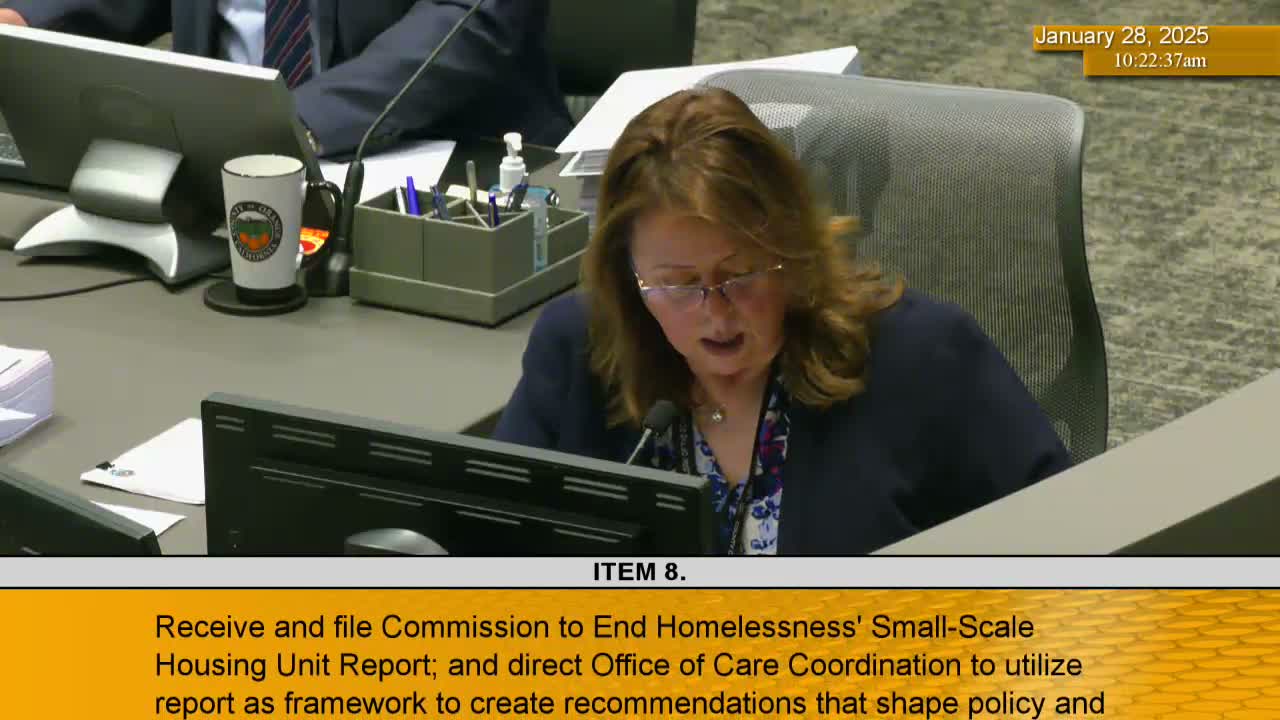
The item (No. 8) was introduced by the clerk as "receive and file commission to end homelessness small‑scale housing unit report and direct Office of Care Coordination to utilize report as framework to create recommendations that shape policy and design programs." The board heard roughly two dozen public speakers, including faith leaders, ACLU representatives and members of local advocacy groups such as Housing Is a Human Right OC, who urged the board to pair the report with a dedicated funding mechanism such as a housing bond.
Public commenters described recent unhoused deaths across Orange County and pressed supervisors to move from reports to immediate action. "Housing ends homelessness," Thomas Fielder of Housing Is a Human Right OC told the board. Multiple speakers asked the board to place a housing bond on the ballot and to prioritize conversion of motels and Project HomeKey sites to get units online faster.
Board members acknowledged the urgency. Supervisors described existing and pilot programs: a rental assistance pilot that reportedly kept 315 people from becoming unhoused (162 children among them) and the county’s work leveraging Project HomeKey to convert motels into housing. Supervisors emphasized barriers beyond funding, including finding sites that cities will allow and rising construction costs for permanent supportive housing (per‑unit costs cited by a supervisor rose from roughly $345,000 in 2018 to $550,000 in 2022 and were described as likely to exceed $1,000,000 now).
The board moved and seconded the recommendation to receive and file the report and to have staff use it as the framework for recommendations and program design; the motion carried unanimously.
What’s next: Board members asked staff to inventory county lands suitable for small‑scale housing, continue Project HomeKey conversions where cities cooperate, and return with more details on funding needs and program implementation.