Get Full Government Meeting Transcripts, Videos, & Alerts Forever!
Get email alerts on the Accountability Plea Review topic
No spam. Unsubscribe anytime.
Orange County Supervisors Continue Call for Review of Andrew Do Plea, Direct Counsel to Draft Amicus Brief
Summary
After hours of public comment and divided debate, the Orange County Board of Supervisors voted to continue supplemental item S26C and directed County Counsel to draft an amicus/victim-impact filing asking federal prosecutors to reassess the plea agreement and sentencing recommendation for former Supervisor Andrew Do.
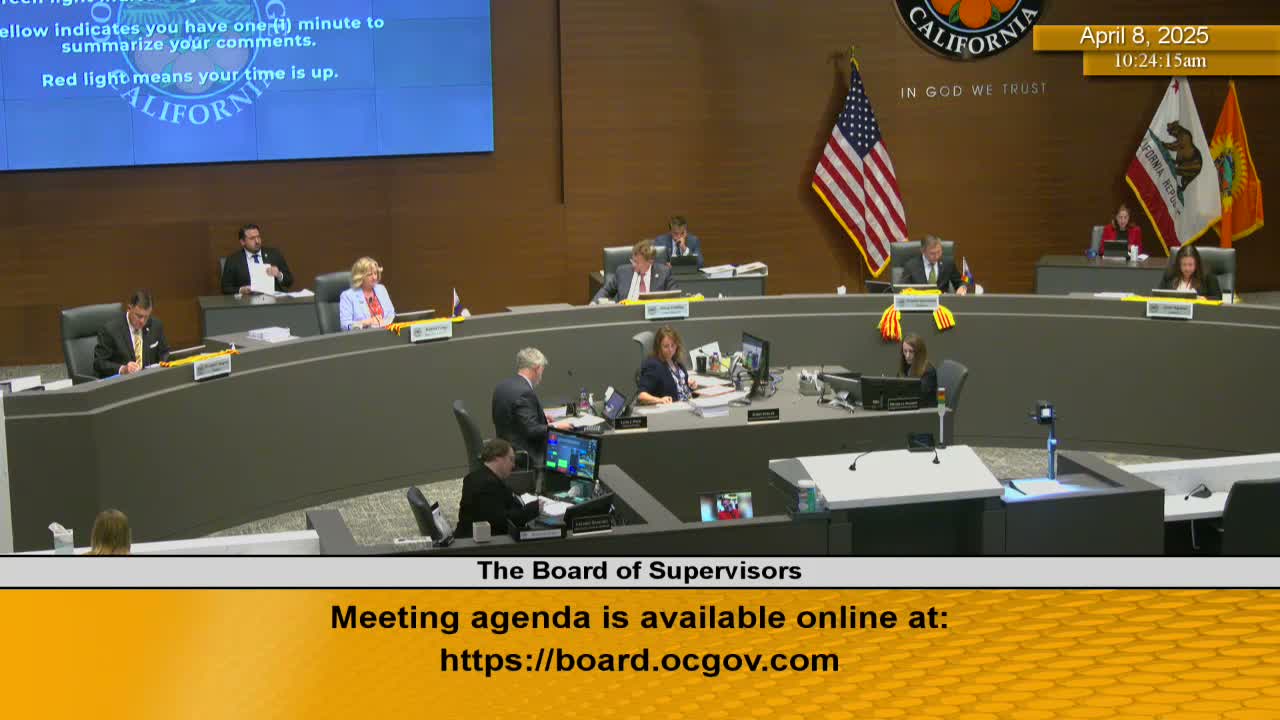
The Orange County Board of Supervisors on April 8, 2025 continued consideration of a resolution urging the U.S. Department of Justice to review the plea agreement and sentencing recommendation in the federal case involving former Supervisor Andrew Do, and directed County Counsel to begin drafting an amicus or victim-impact filing ahead of a June sentencing.
Supporters — including dozens of Vietnamese American community members and veterans who spoke during an extended public-comment period — urged the board to press federal authorities to seek stiffer accountability after what speakers called an insufficient plea. "No one should be above the law," said Phat Bowie, a former Garden Grove councilman and chair of a Vietnamese American group, during public comments in favor of the resolution.
The item (listed on the agenda as S26C) was introduced for board consideration earlier in the meeting; the clerk read the item as asking that the DOJ "review and assess terms of plea agreement and sentencing recommendation for former supervisor Andrew Do" and to authorize County Counsel to send a formal letter to "Attorney General Pam Bondi" requesting a review and advancement of related investigations.
Sponsor remarks cited multiple concerns about the plea deal. "Since Andrew Do's plea agreement became public last October, the community has been very outspoken," the resolution's proponent told the board, listing charges the speaker said the DOJ could have pursued, including bribery, conspiracy to defraud the United States, theft concerning federal funds, wire fraud and money laundering. The sponsor argued the plea and proposed sentencing range — which the sponsor said capped at roughly five years — "does not reflect the gravity of the crime." The resolution text and sponsor remarks also cite claimed losses and bribe figures that speakers and members placed in the multi‑million dollar range.
Several supervisors supported asking for a reassessment but stressed the limits of the board's role. Supervisor Katrina Foley, noting her background in litigation, said new facts — including what she described as evidence that the former supervisor received attorney‑client communications forwarded to a private account — warranted asking federal prosecutors to reconsider whether the plea terms remain appropriate. Foley also read elements of the federal agreement and listed forfeitures and restitution the agreement requires, including a forfeiture of properties in Tustin and Santa Ana, and bank forfeitures she cited as about $1,700,000 and additional funds held in the name of Aloha Financial Investment; she said a restitution payment of about $730,000 is required to be paid at or before sentencing.
Not all supervisors agreed the board should directly urge the DOJ to reopen the plea. Supervisor Don Wagner said he shared the public's outrage at the conduct alleged in the case but argued the board should not "put our 2¢ in" on prosecutorial charging and sentencing decisions. "Let the system of justice work," Wagner said, adding that judges and prosecutors have the expertise and access to evidence the board does not.
Faced with a divided board, members sought compromise: some urged an immediate resolution as written; others proposed narrower language or a delay to allow counsel and staff to prepare an amicus brief or a victim-impact statement for the court. After floor debate, the board voted to continue the matter for two weeks (to the meeting of April 22) and directed County Counsel to prepare a draft amicus or victim-impact filing to be circulated by the next meeting.
The board did not vote to ask the DOJ directly to undo any plea or to file a formal challenge; it instead asked staff to prepare materials the county could submit in court and to provide the draft at the next meeting. The item will return to the board's agenda for a vote after that review period.
What happened next: the board recessed for closed session after concluding the public-business portion of the morning agenda.