Get Full Government Meeting Transcripts, Videos, & Alerts Forever!
Get email alerts on the Water Rates topic
No spam. Unsubscribe anytime.
Bowie council stalls water‑rate increase after split second reading; debate continues
Summary
Council failed to advance Ordinance 2025‑O2 on second reading after a 2–3 vote and the mayor announced a veto because the council was not at full membership; lengthy follow‑on discussion focused on TCEQ mandates, engineering costs and distributional impacts on residents and businesses.
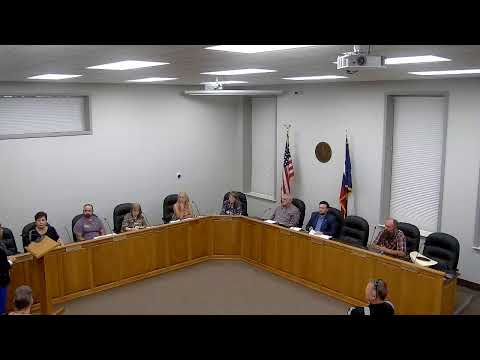
On second reading the Bowie City Council did not adopt Ordinance 2025‑O2, a proposal to amend the city’s water rates. The motion failed by a 2–3 vote and the mayor announced a veto because the council did not have a full seated body present for the decision. Councilmembers then resumed a more detailed discussion of rate options and project costs later in the meeting.
Councilmember Donna said, “No one wants to see a water increase,” acknowledging political sensitivity while urging council to weigh investments needed for future capacity. Staff and engineers told the council that engineers’ fees for project planning would likely run on the order of $300,000 and that advancing the required projects to satisfy regulatory requirements could require on the order of millions in capital: “we're looking at $19–$20,000,000” to get engineering and initial projects started, staff said.
Engineers and public‑works staff emphasized a regulatory driver. Stoney, an engineer on the water projects, warned that the Texas Commission on Environmental Quality could impose mandates or take corrective action if the city fails to meet requirements, saying that failing to plan could leave the city subject to outside enforcement. Councilmembers debated how to structure any increase — raising the base rate versus increasing per‑gallon usage charges — and discussed the effect on fixed‑income households, small businesses, and large water users. One member suggested an across‑the‑board per‑gallon increase that would give customers more control over costs; others argued that base‑rate changes would be simpler to bill and more predictable for customers.
During public comment, John Halbrook, president of Amon Carter Water, told the council his wholesale operation had seen “our cost the last 3 years have gone up over 62%,” and asked the city to consider contract terms that limit increases tied to capitalization of seller systems. Halbrook also said his group purchased 870,000 gallons the prior month and had bought 3,000,000 gallons in a hot week mid‑summer, underscoring seasonal demand variability.
The mayor told the council the item will return to a future meeting (the chair referenced April 22 as the next chance to vote). Council members asked staff to bring alternative rate structures and more detailed monthly financials back to the council for consideration before a final vote.
What’s next: Staff will prepare alternative rate‑structure scenarios and monthly financial reports for the council to review at the next meeting; the council signaled the need to balance regulatory compliance and infrastructure funding with protections for low‑income residents.