Get Full Government Meeting Transcripts, Videos, & Alerts Forever!
Get email alerts on the Executive Session topic
No spam. Unsubscribe anytime.
OGEC trains Newberg‑Dundee board on executive‑session rules and grievance timeline
Summary
OGEC presenters told the Newberg‑Dundee School District board the law allows private deliberations but requires final decisions in open session, reviewed allowable executive‑session topics, and explained the new grievance timeline that gives boards 21 days to respond to written complaints.
Charlie Esparza of the Oregon Government Ethics Commission led a July 24 training for the Newberg‑Dundee Public School Board on how and when the board may move from open meeting to executive session under Oregon public meetings law.
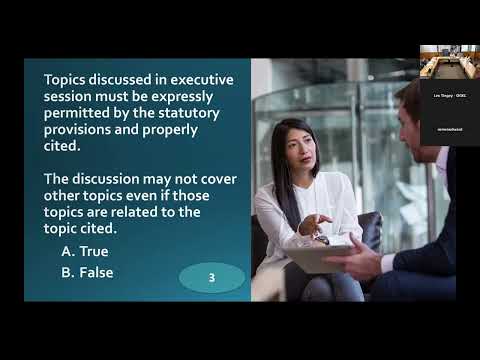
Esparza emphasized the central principle that executive sessions do not replace public final actions: “even though you go into executive session, you always make your final decision on any topic in public session,” he said, stressing transparency and that statutory citations should be clear when invoking an executive session.
The presenters recommended using the Oregon Attorney General’s manual and OGEC checklists when preparing to enter executive session. OGEC’s Lex said the board should read statutory references aloud when announcing an executive session so the public understands the reason: “we do recommend that you read the entire statement for the reason you’re going into,” she said.
OGEC reviewed common allowable reasons for executive session under ORS 192.660, including initial employment (with prerequisites), discipline or dismissal when the individual does not request an open hearing, deliberations with a designated labor negotiator, certain real property transactions tied to a specific transaction, consultation with legal counsel regarding current or likely litigation, and consideration of records exempt from public inspection. The presenters noted recent changes that explicitly allow deliberations relating to the safety of staff and volunteers and to cybersecurity infrastructure in response to threats.
On procedural questions, OGEC said there is no statutory minimum for executive‑session minutes but that minutes must state the “true nature” of the discussion; presenters offered to follow up with examples for the district. They also explained media access: media generally may remain in executive session except in defined cases (for example, certain labor negotiator sessions, expulsion proceedings for students, and when the media is a party to related litigation).
OGEC summarized an updated grievance process under recent public meetings law changes: complainants must submit a written grievance within 30 days of an alleged violation and the public body then has 21 days to respond (to acknowledge receipt and either deny, admit but deny a violation, or admit and commit to remedies). On that point OGEC said boards should prepare a clear internal pathway for receiving grievances; one board member said the 21‑day response window feels short for a monthly board.
Esparza and Lex closed by describing OGEC’s advisory resources and remedies for violations (letters of education, training requirements and, in some cases, civil penalties up to $1,000), and encouraged boards to contact OGEC for staff advice or formal opinions when questions arise.
The training ran through OGEC’s sample scripts and checklists and included polling and knowledge checks. The session ended with a public Q&A about how board members should request future executive‑session topics and how to cite topics properly when announcing an executive session.