Get Full Government Meeting Transcripts, Videos, & Alerts Forever!
Get email alerts on the Education Funding topic
No spam. Unsubscribe anytime.
Newberg SD 29J finance advisers review state school fund reconciliations after $3.1 million swing
Summary
A finance advisory committee meeting on Oct. 16 reviewed Oregon Department of Education estimates and reconciliations that reduced Newberg SD 29J's expected state school fund payment by about $3.1 million for prior years, discussed budgeting fixes and possible May 2025 adjustments.
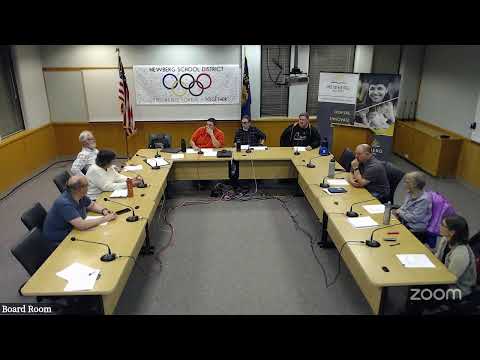
Newberg School District 29J's finance advisory committee spent most of its Oct. 16 meeting on a detailed tutorial and reconciliation of the state school fund after the district's most recent ODE reconciliation reduced the district's expected state payment by roughly $3.1 million.
The tutorial, led by Michelle Morrison and staff finance members including Galen, explained the ODE estimate cycle (district December estimates, formal ODE estimates, and final reconciliations published in late April/early May) and how enrollment measures and local property-tax collections flow through to the district's per-student rates. "They're public. You don't need to log in to see them," Morrison said of the ODE estimate pages used for the calculations.
Why it matters: the committee heard that timing and data differences between a district's internal projections and the statewide dataset can create sizable year-to-year swings. In Newberg's example, a combination of lower property-tax collections and other adjustments produced a formal decrease in state school fund recognition of about $3.1 million compared with earlier estimates; the packet shows a May 2024 payment adjustment of roughly $1.25 million was already applied. District staff said audited, systemwide calculations drive the final reconciliation and the next opportunity for a multi-district adjustment will be in May when audited financials are incorporated.
Details and projections: presenters walked the committee through three years of ODE estimate snapshots for the 2022-23 and 2023-24 cycles and explained technical drivers: ADMR/ADMW (average daily membership measures and the extended counts that pay on the higher of prior/current year), special-education weightings (an 11% state cap and a statewide pool for districts that spent more), teacher-experience adjustments and the transportation grant (typically reimbursing about 70% of eligible expenses). Committee members reported a net decline of about 62.53 students in one comparison that corresponded to an estimated revenue loss in the ~$600,000 range.
Reconciliation and audit implications: Galen told the committee the large decrease in recognized state funding applied in May 2024 and that page-by-page reconciliations in the packet show where the variance occurred. Staff cautioned that while staff estimate a possible $2.8 million'$2.9 million positive adjustment could come back in a future May reconciliation for 2023-24, auditors and accounting rules limit whether that sum can be booked as a receivable before it is actually received. "We won't get a $3,000,000 adjustment now while they still haven't even...and I don't know that our auditors would book it," staff said.
Budget and controls: the committee discussed near-term budgeting responses. District leaders recommended truing up ODE estimates in December/January as more tax-turnover and enrollment data arrive, tightening contract approval and encumbrance practices, and using manual position-control lists to prevent hiring or FTE changes without CFO and superintendent sign-off. Staff said the district may need a supplemental budget and noted current-year precautions (not-to-exceed contract encumbrances, shifting some costs into grant funds when allowed). The packet shows the district ended the year with a negative ending fund balance that staff estimate will narrow to between roughly $1.2 million and $1.7 million after reconciliations and audit adjustments.
Other items tied to funding: the committee reviewed maintenance-of-effort obligations for special education (staff reported a MOE of about 8.45 for 2023-24 including ESD contributions) and discussed missing the state deadline to obtain an indirect grant rate. Staff estimated the district could be foregoing about $100,000'$115,000 in grant-overhead reimbursements by not having charged indirects in recent years.
What happens next: Galen and finance staff said they will pursue ODE collection openings or estimate adjustments as appropriate, present reconciliations and recommended changes to the full board at the November meeting, and continue finance advisory oversight before the district adopts its 2024-25 budget. The committee scheduled its next meeting for Nov. 6 at 6 p.m.
The discussion was technical and focused on reconciling published ODE figures to district accounting; no formal vote was recorded on the matters discussed.