
Committee weighs changes to ejectment process, payment-in-court rules and post-eviction property handling
Get AI-powered insights, summaries, and transcripts
Subscribe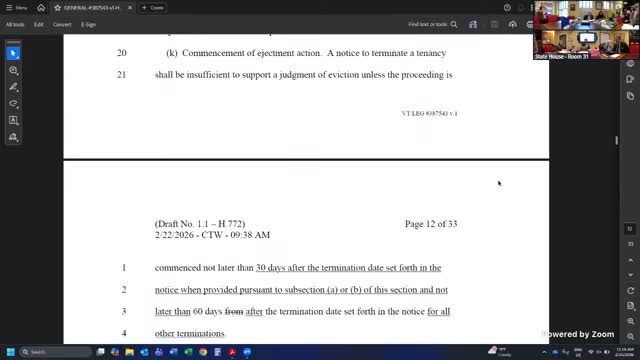
Summary
Members debated shortening time to bring ejectment actions for nonpayment, whether courts should be able to order partial payments into court, rules for alternate service of process, and a clarified timeline for landlords to dispose of tenant property after legal possession.
The House Committee on General & Housing examined several court-procedure changes in the redraft of bill 772, including tightening timelines for ejectment filings, clarifying who may effect service of process, and resolving how long tenants have to remove property after legal dispossession.
Counsel proposed shortening the statutory window for bringing ejectment actions in cases of nonpayment or serious material breach from 60 days to 30 days, increasing pressure on landlords to move a case forward after giving notice. Committee members asked for additional drafting to ensure the rule accounts for practical constraints and judicial processing times.
A separate, contested proposal would remove the court’s ability to order partial payments into court during an ejectment proceeding. Supporters of removing partial payments argued it avoids prolonged hearings and inconsistent awards; others — including some who cited arrears-assistance practicalities — said partial payments can facilitate negotiated resolutions for tenants with limited means. "Any payment into court is a plus if the landlord wishes to use it," one committee participant observed; the committee’s working sense favored leaving partial payment authority in the draft for now and returning to the question during further redrafting.
The committee clarified that when a court orders an alternate method of service, that order should apply to the remainder of the proceeding, including post-judgment steps, to reduce repeated court petitions. Members also discussed whether sheriffs must perform service in every case; counsel noted civil-procedure rules do not strictly require that only sheriffs can serve and that certain writ-of-possession formalities remain tied to the sheriff’s office.
On post-ejection property handling, counsel said the redraft aims to reflect the practical interpretation offered by witnesses: once a landlord is legally restored to possession (for example, after sheriff action), the landlord may dispose of tenant belongings in accordance with the statutory timeline. Members debated what waiting period best balances tenant access to belongings with landlords' need for clarity; the draft retained a 14-day baseline as a compromise but committee members asked counsel to clean up language and examples ahead of the next meeting.
No formal votes were taken; counsel will prepare a revised draft that incorporates the committee’s direction and technical fixes for review when the panel reconvenes.