Loudon County town hall debates Matlock Bend borrow‑pit rezoning as officials urge preservation of 'Jackson law'
Loading...
Summary
At a Feb. 17 town hall, Loudon County officials and residents debated a proposal to rezone 98 acres as borrow pits for the Matlock Bend landfill. County attorney Elizabeth Murphy urged preserving the state 'Jackson law' to keep local say over new landfills while commissioners listed strict stipulations for the rezone; no formal votes were taken.
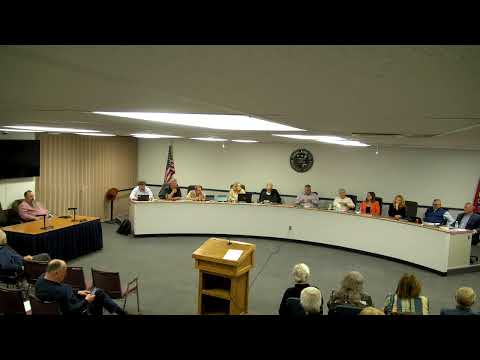
At a Feb. 17 town hall aimed at correcting misinformation about a proposed rezoning for borrow‑pit access at the Matlock Bend landfill, Loudon County officials and residents discussed contract history, environmental oversight and zoning conditions without taking a formal vote.
Elizabeth Murphy, an attorney who said she has litigated multiple landfill cases and later identified herself as having spoken to Metro Nashville on the same statute, urged the county to "please do not mess with the Jackson law," describing it as "an Uber zoning law" passed by the Tennessee legislature that gives local governments first authority to accept or reject new landfills or solid‑waste facilities. Murphy said the statute exists because the state regulatory agency (TDEC) can only evaluate technical permitting issues — "Your job is to make sure that it doesn't contaminate the groundwater," she said — and cannot consider proximity to schools or neighborhoods in the same way local bodies can.
The town hall focused heavily on the 2022 contract that authorized an expansion process at the Matlock Bend site. Murphy described that contract as "highly unusual," saying the contract initially contemplated roughly 26–27 acres of expansion but later was modified in part 2 to a smaller six‑acre change. She told the room that the contract issues remain unresolved and that the commission had, at points, taken the position that the operator (Republic) "breached the contract" by not completing the larger acreage originally discussed.
Residents pressed for clarity about what the current rezoning would permit. Commissioners and staff described proposed stipulations that would attach to a rezoned borrow‑pit parcel if the county approves it: a 400‑foot buffer from Highway 72, 200‑foot buffers from neighboring properties, at least 2,000 feet of additional paved roadway, relocation of the scale house and wheel wash "a minimum of 1,800 foot beyond the current paved road," a permitted‑use limitation restricting the parcel to "a borrow pit serving the existing landfill facility only," and an undisturbed vegetation strip along Matlock Bend. Officials said those conditions are intended to keep borrow‑pit soil on‑site and limit traffic and dust impacts to nearby neighborhoods.
Residents also raised questions about permit numbers and acreage. County presenters said the three parcels under consideration total about 98 acres (the "rezone" parcels), the existing permitted footprint discussed in some documents was cited as roughly 47 acres of active cells, and other numbers (a 151.94‑acre figure) were referenced in the meeting as part of the broader permitted or planning footprint. Several attendees asked how much of the 98 acres is usable after buffers and stipulations are accounted for.
Legal and enforcement limits were a recurring theme. Murphy and other commissioners noted that TDEC is the state enforcement authority for technical regulatory compliance, but they also said the 2022 agreement lacked strong enforcement language and that the commission has been pursuing stronger conditions to create "checks and securities" while acknowledging Republic runs site operations and holds many design and construction responsibilities. Murphy said an independent local engineer, Chris Klein, has been added to advise the commission on technical matters.
Speakers also discussed pending state legislation that could alter landfill operations. Attendees referenced a bill (discussed during the meeting as House Bill 2134) that, depending on final language, could prohibit counties from disposing of solid waste outside their boundaries without a host‑community agreement after July 1, 2026 — an outcome that, speakers warned, could change the commercial and contractual landscape for regional disposal.
No formal rezoning vote or commission action was taken at the town hall. Commissioners and staff repeatedly urged residents to continue to attend the solid waste commission’s regular meetings (third Thursday at 6 p.m.) and noted that the county commission would consider related items on March 2. Commissioners also described options to limit future uses of the Matlock Bend strip — for example, selling a small, roughly seven‑acre finger of land with deed restrictions that would limit its future development — and reiterated that any attempt to sell the landfill property would require stakeholder approval beyond the solid waste commission.
The immediate outcome was a commitment to keep the conversation open: officials said they would continue to push for enforceable stipulations tied to any rezone, pursue technical inspections and oversight, and request further input from the county attorney and engineer as they work through unresolved contract issues.