Get Full Government Meeting Transcripts, Videos, & Alerts Forever!
Get email alerts on the Gas Electric Coordination topic
No spam. Unsubscribe anytime.
FERC and state regulators launch federal‑state collaborative on gas‑electric coordination; GEAR outlines voluntary readiness forum
Summary
Federal and state regulators opened a new collaborative to address gas‑electric coordination risks to reliability. Commissioners described regional constraints and GEAR (Gas Electric Alignment for Reliability) reported eight recommendations, an extended charter and a voluntary Natural Gas Readiness Forum.
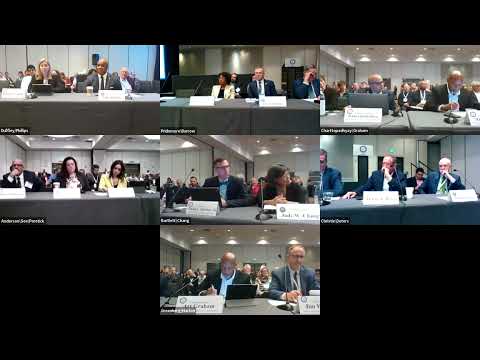
WASHINGTON — Federal and state utility regulators convened an inaugural federal‑state collaborative hosted by the Federal Energy Regulatory Commission to work on gas‑electric coordination and reduce the risk that natural‑gas supply shortfalls could impair electric reliability.
Chairman Willie Phillips, who opened the session, said reliability remains the top priority: "reliability is and always must be job number 1," and warned that it is "unacceptable for that fuel to not be available to meet our energy supply needs, especially during emergencies." The meeting was recorded for docket AD20Fourseven, and the public may file comments through FERC's e‑filing system.
The meeting gathered state commissioners from multiple regions who gave brief, region‑specific accounts of operational realities. Kim Duffley of the North Carolina Utilities Commission said recent winter storms show the interdependence of gas and electric systems and urged "an all‑systems planning lens," adding that availability of gas during emergencies "can be a matter of life and death." Commissioners from New England, the Midwest, the Southeast and the West described constraints ranging from limited pipeline deliverability and storage to differing market structures and permitting authority.
David Reisner of FERC summarized national context and posed technical questions for the group. He noted that about "43% of generation is gas" and that more than half of U.S. households heat with gas, framing near‑term priorities including improved data sharing, weekend market liquidity, incremental storage and potential demand‑response mechanisms for natural‑gas systems.
The group then heard a report from the Gas Electric Alignment for Reliability (GEAR) working group, chaired by Commissioner Tricia Pridemore (Georgia). Pridemore said GEAR — a NARUC‑led working group that pairs seven state commissioners with seven industry representatives across the gas value chain — has identified eight priority recommendations. GEAR has extended its charter through November 2025 and announced a voluntary Natural Gas Readiness Forum (NGRF) to convene producers, pipelines, utilities, RTOs/ISOs, federal and state agencies, emergency managers and large consumers to improve operational readiness and cross‑sector communication. The first readiness summit is planned in Atlanta in December.
Pridemore told commissioners GEAR aims to produce "action‑oriented" solutions that operators and engineers can test in real scenarios rather than high‑level policy statements. She described ongoing small groups working on gas storage, demand response, market liquidity, load shed, infrastructure and legal questions identified in RTO/ISO reports.
Commissioners pressed how the collaborative's open discussions would feed into GEAR's work and how success will be measured. Pridemore said GEAR will listen to collaborative sessions, incorporate feasible items into its recommendations, and emphasize operator‑driven, implementable measures.
No formal votes or regulatory actions occurred at the meeting. Organizers framed the collaborative as a sustained dialogue to coordinate federal and state roles, share information, and develop practical steps to reduce the operational risk that gas shortages pose to electric reliability.
Next steps announced included continued monthly GEAR meetings, in‑person working sessions as needed, and the NGRF kickoff in Atlanta; GEAR plans a final report of recommendations for the November 2025 NARUC meeting.