Get Full Government Meeting Transcripts, Videos, & Alerts Forever!
Get email alerts on the Public Participation topic
No spam. Unsubscribe anytime.
FERC workshop: commissioners and staff tell the public how to write comments that matter
Summary
At an OPP workshop, FERC officials urged commenters to be brief, direct, and specific: tie submissions to law and local impacts, meet deadlines, avoid repetitive form letters, and use e‑subscription or eLibrary to follow dockets. Panelists outlined five practical tips and answered audience questions.
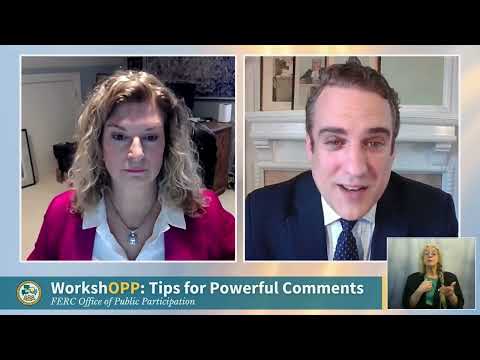
The Federal Energy Regulatory Commission’s Office of Public Participation (OPP) hosted a workshop to teach members of the public how to write effective comments for FERC proceedings, urging brevity, clarity, and concrete, project‑level facts.
Commissioner James Danley told the online audience that any filing “should be as absolutely brief as possible,” and that the most persuasive comments state whether the filer supports or opposes a proposal up front, then quickly explain the legal and factual reasons for that position. He stressed that FERC is an adjudicatory body that must base decisions on law and “substantial evidence in the record,” so comments that supply new, specific evidence about local impacts are especially valuable.
The panel of office directors explained how that guidance applies across FERC’s work. Terry Turpin, director of the Office of Energy Projects (OEP), said OEP issues roughly 60–70 environmental review documents each year and reviews thousands of project filings; he said the office receives on the order of 9,000 individual comment letters or submittals annually and uses geographic specificity to focus environmental analyses. Jett Gebhart, director of the Office of Energy Market Regulation (OEMR), noted many filings are governed by statutory deadlines (for example, some rate‑related filings must be acted on within roughly 60 days) and recommended filing within the published comment window—often 21 days for electric rate filings—so staff have adequate time to consider remarks. Jignasa Gaddani, director of the Office of Energy Policy and Innovation, emphasized that rulemakings combine outreach with a need for a complete written record and that commenters should offer concrete alternatives, quantification of impacts when possible, and references to supporting studies or public sources.
OPP staff then offered five practical tips: organize your submission and verify the docket number; state your objective immediately; support assertions with data or examples; describe specific impacts on you or your community; and focus on issues within FERC’s statutory authority. Amanda Bradshaw of OPP summarized that comments are not treated as votes—“it’s not about the number, but the content”—and that group filings or coalitions are acceptable but do not automatically carry greater weight than distinct, substantive comments.
During audience questions, commissioners and directors addressed common concerns: elected officials’ filings become part of the public record and are weighed like other submissions; tribal governments receive government‑to‑government consultation and their input is given particular attention on cultural and resource issues; form letters are recorded but generally provide less analytical value than distinctive, evidence‑based comments; and ex parte rules limit off‑the‑record discussions in contested dockets, so written filings are the primary route for influencing decisions. Panelists also recommended that interested parties use FERC’s e‑subscription service or eLibrary to monitor docket activity and deadlines.
What happens next: slides and a recording of the workshop will be posted by OPP on FERC’s website for reference, and OPP staff offered follow‑up assistance for people who need help finding a docket or understanding timelines. The workshop reiterated the message that clear, timely, and specific public submissions strengthen FERC’s administrative record and can shape staff analyses and, ultimately, agency decisions.