Get Full Government Meeting Transcripts, Videos, & Alerts Forever!
Get email alerts on the Permitting Ag Buildings topic
No spam. Unsubscribe anytime.
Resident urges county to streamline permitting for rural ag buildings; staff cite state, FEMA and fire-code requirements
Summary
At the Dec. 11 Lea County Commission meeting a resident thanked commissioners for a school grant and urged a review of county permitting for agricultural structures, calling the process 'burdensome.' County staff said many requirements derive from state model codes and FEMA floodplain rules and offered to meet with the resident for a case review.
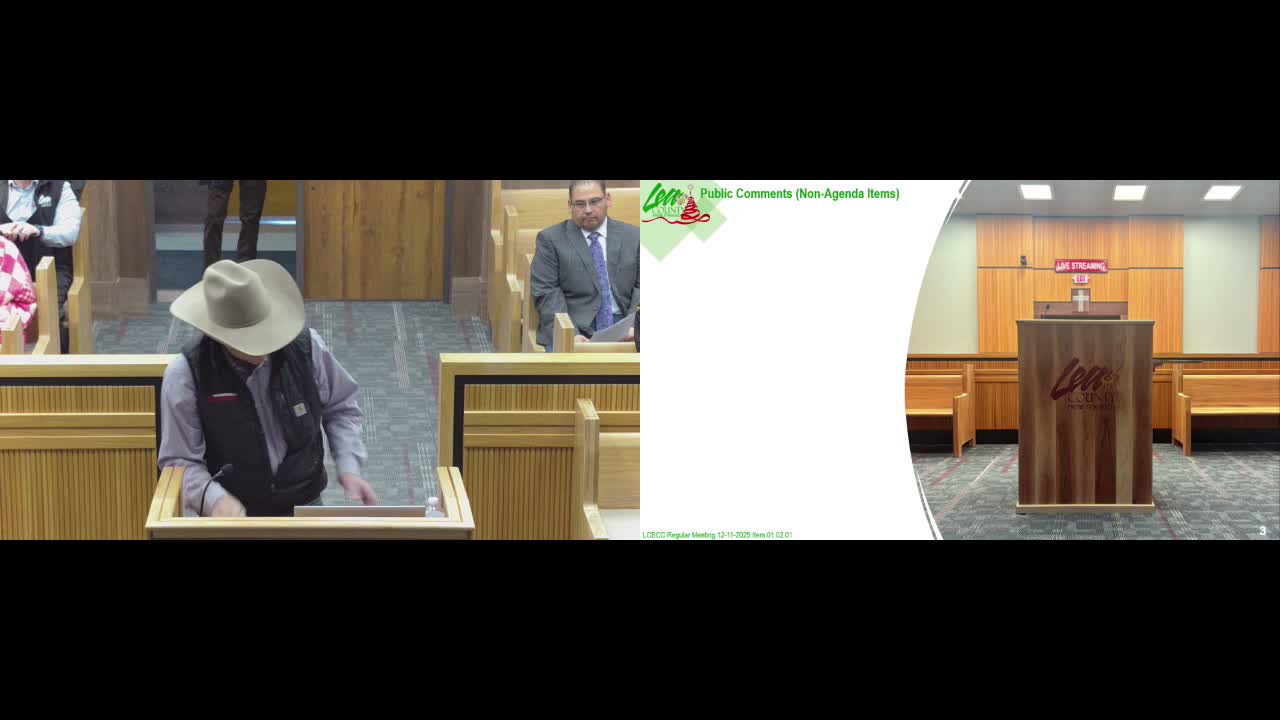
CJ Ken Solving, a Crossroads resident and trustee of Lea County Electric, used the public-comment period at the Dec. 11 Lea County Board of County Commissioners meeting to praise the commission for a $6 million contribution to Tatum schools and to urge changes to permitting for agricultural buildings in rural areas.
"For an ag building, my property, a metal building should not be treated the same as if I want to build a 5,000-square-foot home," Solving said, calling the current sequence of requirements "one step after another" and saying the process had taken about six months in his case. He asked the commission to consider separate, faster tracks for noncommercial agricultural structures.
County staff responded that many of the requirements Solving described—building permits, engineered-road standards and flood-plain certifications—stem from state-adopted model codes and federal FEMA rules. A county official explained that the International Fire Code requires an all-weather access surface for emergency vehicles and that FEMA flood-plain certifications affect eligibility for federal flood insurance, so those items must be reviewed before allowing electrical service and final approvals.
The staff member offered an immediate follow-up: an officer would sit down with Solving after the meeting to review his application and paperwork. The county also described the local code-enforcement process for derelict properties: a 10-day warning period, citations if owners do not comply, magistrate court summons for noncompliance and, if the county performs cleanup, a lien against the property.
Solving also flagged costs he had incurred, including the need to re-stamp engineered drawings with a New Mexico engineer. County staff acknowledged that some state requirements add costs but said the county enforces the ordinances and codes already in place and is willing to meet with property owners to clarify needed documents and timelines.
What’s next: Staff offered to meet with Solving to review his file and application status. Commissioners did not take formal action on the complaints during the meeting.