Get Full Government Meeting Transcripts, Videos, & Alerts Forever!
Get email alerts on the Water Policy topic
No spam. Unsubscribe anytime.
Lea County backs local hearings, reuse of treated produced water
Summary
The commission approved a resolution urging state regulators to hold hearings in affected communities and expressing county support for responsible reuse of treated produced water for non‑potable uses.
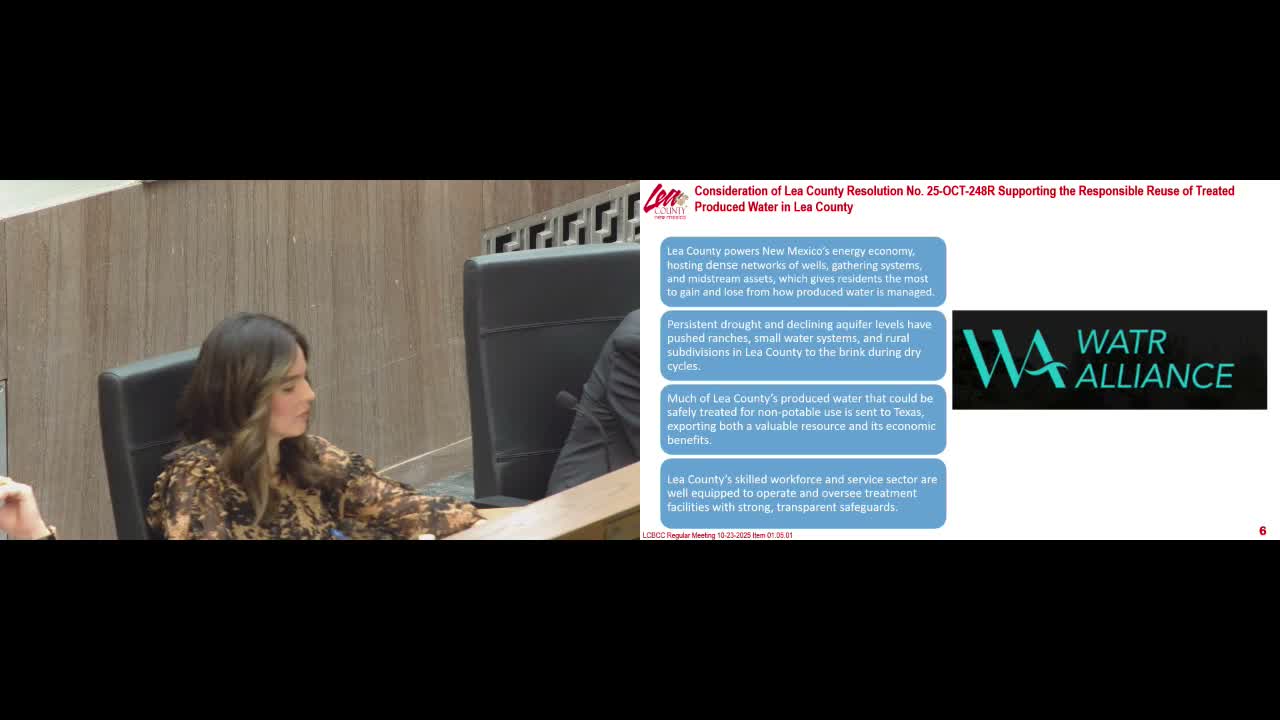
The Lea County Board of County Commissioners on Oct. 23 passed a resolution supporting the responsible reuse of treated produced water for non‑potable uses and urging the New Mexico Water Quality Control Commission to hold hearings in communities most affected by produced‑water projects.
Matthew Gonzales, executive director of the Consumer Energy Alliance, told the commission that the county should press the state for local hearings and emphasized potential economic and water‑supply benefits. "We can clean it up to a standard that is actually cleaner than drinking water," he said in arguing the county should support reuse projects for industrial, agricultural and other non‑potable purposes. Gonzales also presented a large‑volume estimate: "90,000,000,000 gallons of produced water ... comes up every year," which he said underscored the opportunity to treat and reuse the resource locally.
Commissioners said they want any reuse projects to meet regulatory standards and credible science and said the Water Quality Control Commission should hold hearings in communities that would be affected rather than defaulting to Santa Fe. The board approved the resolution after public comment and a motion by a commissioner.
The resolution is advisory: it expresses the commission's position and asks state regulators to consider venue and local input. County staff said projects would still need to meet all applicable state and federal regulatory requirements prior to any reuse or siting decisions.
What happens next: The county will enter the resolution into the state docket and county leaders said they plan to continue engagement with regulators and local stakeholders.