Get Full Government Meeting Transcripts, Videos, & Alerts Forever!
Get email alerts on the Public Safety topic
No spam. Unsubscribe anytime.
County considers stipend program to boost volunteer firefighter recruitment and retention
Summary
Lee County emergency management presented a voluntary stipend program to recruit and retain volunteer firefighters: stipends would be call‑based (not hourly), not reduce PERA retirement credit, and the county will seek a $25,000 state grant to supplement local funds; commissioners discussed age limits, school outreach and employer constraints.
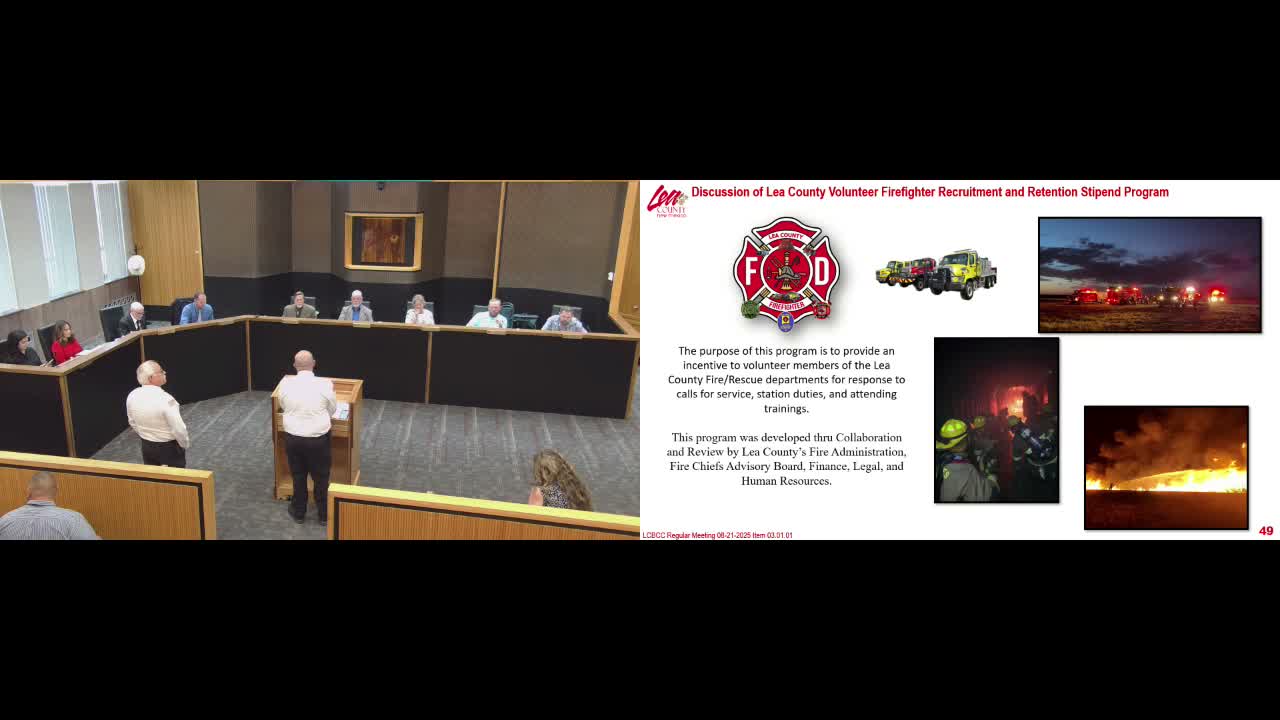
Lee County emergency management on Aug. 21 described a proposed Volunteer Firefighter Recruitment and Retention Stipend Program designed to increase volunteer numbers and reduce coverage gaps in rural districts.
Charlie Pruitt, Emergency Management, told the commission the program was developed with finance, legal, HR and the fire chiefs advisory board to modernize stipend practices and make recruitment competitive (SEG 1959–1969). Pruitt said the stipend would be voluntary, non‑hourly (call‑based rather than a wage), and would not negatively affect PERA retirement credit for volunteers who qualify for retirement credit (10 or 20 years of service) (SEG 1989–1995, SEG 1985–1988).
Key design points: The program would record participation (the county is exploring an app and QR code sign‑ups to streamline check‑in), could tier stipends based on call volume or participation and would include safeguards so PERA credits are not impacted. Pruitt noted a state fire marshal grant opportunity (a $25,000 grant offered in 2024) that could supplement county stipends if the commission approves the program and staff applies for the grant (SEG 2004–2014).
Youth and staffing pipelines: Commissioners asked about age limits; Pruitt said junior membership can begin at 16 with parental approval and that junior members perform support roles (no active firefighting or apparatus driving) until they turn 18. The department highlighted existing outreach at fairs and proposed increased school engagement (FFA, 4‑H) to recruit youth and parents from rural districts where volunteer numbers are critical (SEG 2016–2031, SEG 2048–2056).
Employer and availability concerns: Commissioners raised potential pushback from employers reluctant to release staff during daytime hours for calls; Pruitt acknowledged variability by employer and said turnout is strongest after 5 p.m. and for major incidents. He said some departments see strong rancher and agrarian volunteer participation and that programs emphasizing local outreach have improved recruitment (SEG 2090–2116).
Next steps: Staff said they will continue to refine program details, pursue the state grant if approved by the commission, and work with schools and outreach teams on recruitment materials. The item was presented for discussion; no county appropriation was voted at the Aug. 21 meeting.
Ending: Commissioners thanked emergency management and suggested deeper engagement with schools and local employers; staff will return with program specifics and grant application steps if the commission directs.