Get Full Government Meeting Transcripts, Videos, & Alerts Forever!
Get email alerts on the Local History topic
No spam. Unsubscribe anytime.
Springettsbury history night traces Mahlon Haines’ Shoe House, Haines Acres and publicity campaigns
Summary
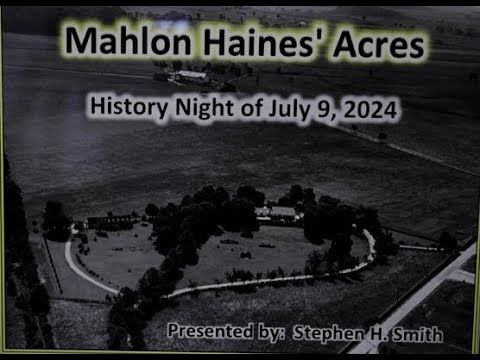
Stephen H. Smith, chair of Springettsbury’s Historic Preservation Committee, outlined Mahlon Haines’ rise from shoe merchant to regional landowner and promoter, describing his farms, the 1949 Shoe House, scouting encampments and the phased development of Haines Acres through the 1960s.
Stephen H. Smith, chairman of the Springettsbury Township Historic Preservation Committee, used the township’s History Night to summarize the life and local legacy of businessman and promoter Mahlon Haines, focusing on his farms, publicity stunts and the residential development that became Haines Acres.
Smith told the audience that Haines began in the shoe business in 1907 and built a regional retail presence before buying farmland in York County. "He names his farm Haines Acres," Smith said in the presentation, describing how the 92‑acre Haines Plains property spanned Springettsbury and neighboring Helen Township and later became the Haines Acres housing development.
Why it matters: Smith framed Haines as both a local developer and a self‑promoter whose events and gifts shaped parts of modern Springettsbury. The talk documented Haines’ investments in farms and buildings, his wartime bond rallies, and the series of planned and completed residential sections that reshaped farmland into neighborhoods and commercial corners.
Smith cited archival sources held by the York County History Center and the Marr Memorial Library and pointed to national press coverage that amplified Haines’ profile. According to Smith, by the late 1940s Haines’ holdings in York County reached roughly 1,900 acres across multiple properties and he also acquired a roughly 3,000‑acre ranch in South Dakota.
The Shoe House: design and public use Smith traced the Shoe House from an initial concept drawing by architect Frederick J. Remp (dated June 28, 1948) through foundation work in October 1948 and interior drawings completed in January 1949. The Shoe House opened in May 1949 and received national attention (Life magazine coverage in June 1949). Smith said Haines initially hosted elderly couples at the Shoe House—paying meals and providing a chauffeur—and later offered it as a honeymoon destination and rental feature to attract publicity.
Community events and publicity Smith described Haines’ public spectacles—buffalo exhibitions, rodeos and a York Horse Show—that drew thousands and raised funds for charity. He reported archival counts such as a 1940 horse show attendance of roughly 5,000 and a rodeo crowd reported as more than 8,000. Smith also noted large scouting encampments tied to Haines’ events (one cited encampment listed 1,525 scouts). The presentation included Smith reading scrapbook excerpts that portrayed Haines as a civic booster who used publicity to promote bond drives and community events.
Native American ceremonies and honorary titles Smith recounted that Haines participated in events featuring Native American performers and that, in several instances reported in his sources, he was ceremonially 'adopted' and given honorific titles (Smith cited appearances and ceremonies involving Hopi and Sioux leaders, including a Pine Ridge ceremony where Haines was named chief flying eagle).
From farm to subdivision Smith walked the audience through the planning record for 'Shoe House Acres' (a 1948 schematic for an initial 108 lots, divided into Sections A–C) and described the staggered development of Haines Acres by Epstein Building Company. He cited a Nov. 1953 purchase by builder Abe Epstein of 55 acres and an option for remaining acreage exercised in January 1955; Smith noted the first Haines Acres house sold on Sept. 20, 1954 (2425 Cambridge Road). He described subsequent sections added through the 1960s and the arrival of a Sunoco station and Jay’s Food Market at Haines Road and Mount Rose Avenue in 1965.
Physical legacy and later changes Smith noted that features such as the Haines farm manager’s house remain at 541 Sundale Drive, that the original Haines barn was demolished in the early 1990s to make room for housing, and that some acreage figures in older publications (Smith cited repeated 800‑acre claims) appear to be overstated compared with his measurements (Smith said his measurement is closer to 400 acres).
What’s next Smith concluded by inviting questions and directing attendees to published booklets and archival holdings for further details. The presentation emphasized archival preservation, local memory, and the way a single promoter and landowner shaped multiple neighborhoods and commercial sites in Springettsbury Township.