Get Full Government Meeting Transcripts, Videos, & Alerts Forever!
Get email alerts on the Local History topic
No spam. Unsubscribe anytime.
Springettsbury history night traces Memory Lanefrom colonial farms to modern redevelopment
Summary
At a Springettsbury Township History Night, Stephen H. Smith outlined Memory Laneits colonial origins, 19th-century road development, the 1959 realignment with Haines Road, and midcentury industrial and retail growth including Caterpillarplus a current sign-restoration fundraiser. Recording and donation details were announced.
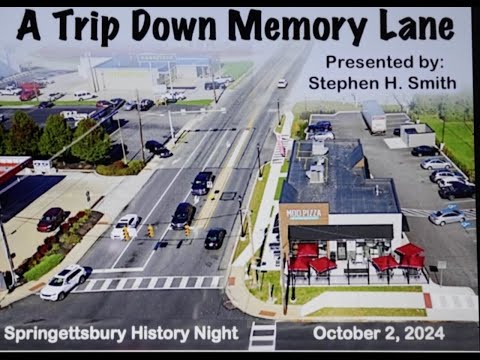
Stephen H. Smith, chairman of the Springettsbury Township Historic Preservation Committee, presented an illustrated history of Memory Lane on March 11, 2025, tracing the corridor from colonial surveys and family farms to postwar industrial and retail development. The roughly 80to85-minute program covered early land surveys, 19th-century roads that became East Market Street and Whiteford Road, the 1959 relocation of Memory Lane to align with Haines Road, and the later arrival and partial departure of major employers and retailers.
Smith said the committee was created by the Board of Supervisors about three decades ago to identify and document locally significant structures and sites, and that the committee now produces short booklets on local history available at events for a suggested $5 donation. "History nights are a venture of the Springettsbury Township Historic Preservation Committee," Smith said, adding that presentations are recorded and posted on the township website.
One practical item Smith highlighted was an ongoing sign-restoration project. In response to an audience question, he described a partnership with the Pennsylvania chapter of the Lincoln Highway Association and Preservation Pennsylvania to remove, refurbish and relocate a neon motel sign to the Agricultural Industrial Museum at the York County History Center. "If you wish to donate to the restoration fund, Preservation Pennsylvania serves as the fiscal manager for this fundraising campaign," Smith said, noting donations are tax-deductible.
On Memory Lane's transportation history, Smith used colonial-era maps and later atlases to show the areaoriginally a 360-acre farm owned by Casper Spanglerand the gradual appearance of roadways. He said Monocacy Road evolved into East Market Street, and described farm lanes that later became North Hills Road and Haines Road. Smith pointed to 19th- and 20th-century maps and aerial photos to document how the railroad (completed between York and Wrightsville by 1840) and later commercial development shaped the area.
Smith recounted traffic and safety problems at the East Market Street and Haines Road intersection in the 1950s that led to condemnation and reconfiguration of the south end of Memory Lane. "Memory Lane was moved in 1959 to align with Haines Road," he said, describing the loss and relocation of parking and businesses at the corner and the subsequent installation of improved signals and drainage. He also noted recurring flooding at the Market Street intersection and described the placement of a roughly 6-foot drainage pipe into 3 Mile Run to mitigate the problem.
The talk covered midcentury industrial growth, including Caterpillar's purchase and expansion in the early 1950s. Smith said the Caterpillar manufacturing plant reached peak employment near 1,900 workers, ceased manufacturing here by 1998, and the large vacant building was later redeveloped by an out-of-state developer into what Smith called "Butterfly Commons," a warehousing and light-industry complex after about $40 million in improvements.
Smith cataloged numerous storefronts, restaurants and service businesses by lot and decadefrom truck terminals, Edgecomb Steel (opened 1954), and Sears warehouse activity to longtime eateries and evolving gas-station brands at the northwest corner of Memory Lane and East Market Street. He noted local memories such as the York Diner (moved after the 1959 realignment) and an anecdote that President John F. Kennedy stopped for lunch at the Lincoln Woods Inn in 1960 and traveled Memory Lane as part of his motorcade.
Smith closed by inviting audience questions and offering the committeeprinted booklets and a flyer with restoration-donation instructions. He said the recording will be posted on the Springettsbury Township website several weeks after the event and reminded attendees of the next history night on April 9, 2025, when he plans to present on hotels and inns in the township.
The presentation combined archival maps, estate files, historic aerial photos and local recollections to place Memory Lane's nineteenth-century farm origins in the context of twentieth-century industrial and retail change. The committee asked attendees with additional historical details (for gaps in the presenters research) to contact the presenter for future booklet revisions.