
Judicial branch largely funded but provisos on juvenile services and administrative cuts worry small counties
Get AI-powered insights, summaries, and transcripts
Subscribe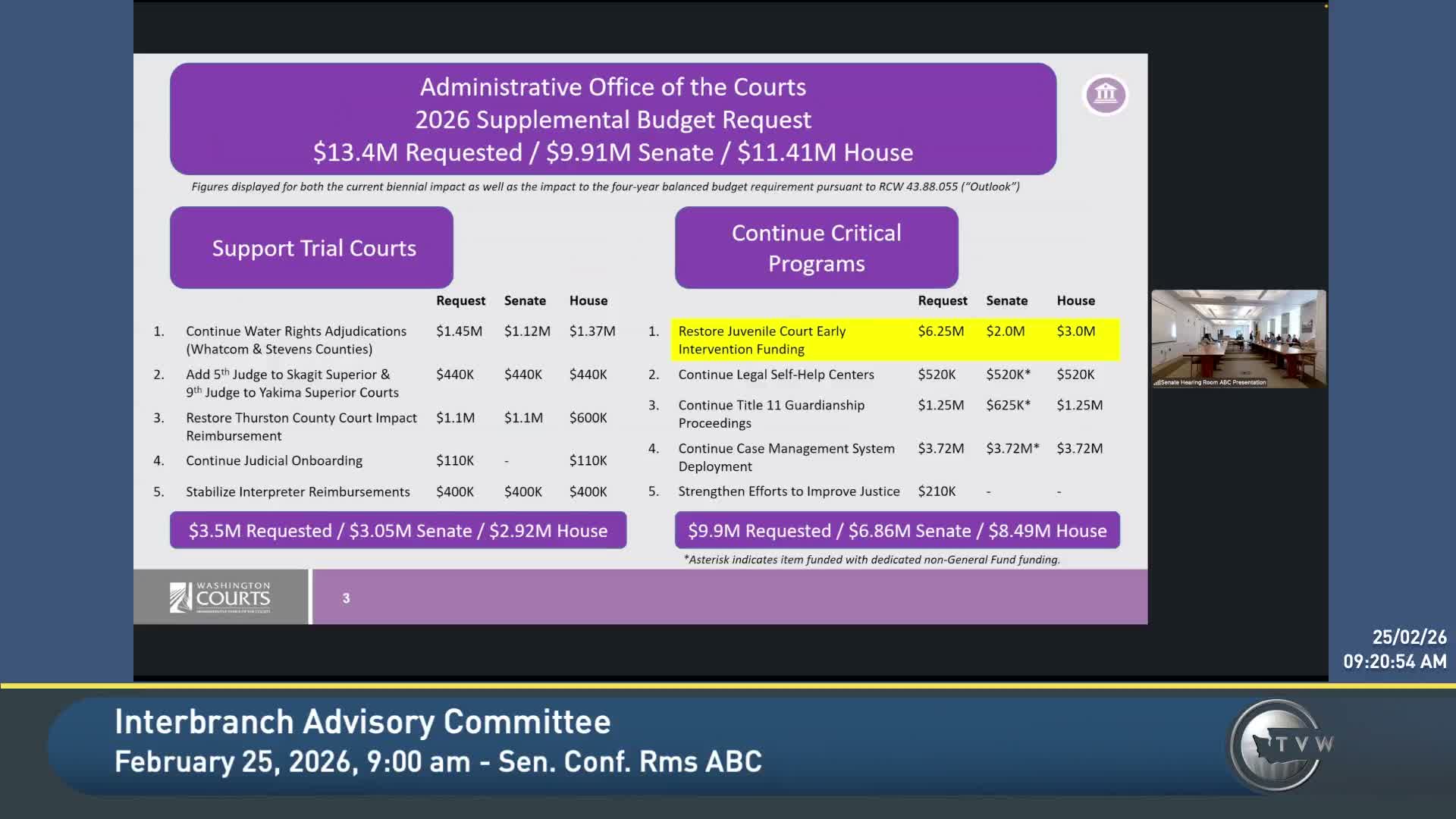
Summary
Budget presentation showed most judicial branch requests funded in House and Senate proposals (interpreter reimbursements, case management, some local court needs), but provisos restricting BECCA funds from covering court staff and administrative reductions raised concerns—small counties like San Juan may lack capacity to deliver services if provisos stand.
Chris Stanley, the Administrative Office of the Courts’ chief financial and management officer, presented the branch budget snapshot and said the branch fared reasonably well in both chambers. Key outcomes included full or partial funding for trial court supports: Whatcom County’s water rights adjudication was fully funded and Stevens County received partial startup funding. Both chambers proposed adding judges to Skagit and Yakima Superior courts and the case management system deployment is fully funded (funded from the Judicial Information Systems account).
Stanley said interpreter reimbursements and judicial onboarding for courts of limited jurisdiction were funded (House included $110,000 for onboarding). On juvenile services, the branch requested $6,250,000 to restore the BECCA early intervention program ($1.25M in the current fiscal year and $5M the next); the Senate added $2,000,000 and the House added $3,000,000. "There is language in the bill that restricts funding to non‑court staffing uses," Stanley warned, and stakeholders said that restriction could undermine service delivery in small counties where court staff provide direct interventions.
Jack Murphy of the Washington Association of Juvenile Court Administrators said the proviso presents a real challenge for small counties. "That money also came with language in the budget that funding may not be used for juvenile court staff," Murphy said, noting that in San Juan County the department received about 250 referrals for early intervention services in 2025 but fewer than 10 generated petitions; many services are delivered by court staff in small counties.
Stanley also flagged administrative reductions that hit all state entities (Senate 1.5% ≈ $400,000; House 3% ≈ $790,000) and noted that pass‑through funds to local courts were included in the base calculation inadvertently. House reductions include two positions at the Washington State Center for Court Research. Stanley said the branch is working with legislative staff to mitigate unintended local impacts and to clarify proviso language in conference negotiations.
Next steps: budgets will move through Ways & Means, conference committees, and floor votes over the coming days; members were advised to follow amendments in committee and focus efforts in the conference process to resolve provisos and administrative reduction impacts.