Get Full Government Meeting Transcripts, Videos, & Alerts Forever!
Get email alerts on the Battery Fast Charging topic
No spam. Unsubscribe anytime.
Synchrotron X-rays reveal ways to reduce lithium plating and speed charging
Summary
At a Brookhaven National Laboratory seminar, beamline scientist Lu Ma described NSLS-II x-ray mapping and spectroscopy that distinguish 'dead' lithium during fast charging and showed a two-layer graphite anode design that reduces plating and preserves capacity in 15-minute charge tests.
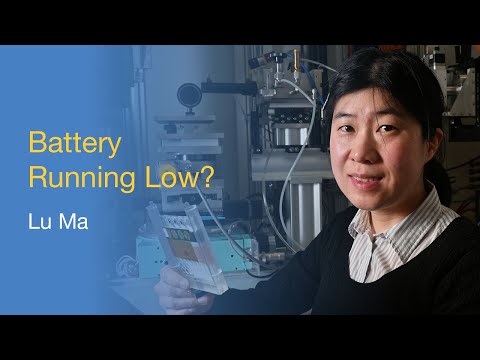
Lu Ma, a beamline scientist at the National Synchrotron Light Source II (NSLS-II) at Brookhaven National Laboratory, said synchrotron x-ray techniques can help engineers reduce lithium plating and enable much faster charging of lithium‑ion batteries.
"I will talk about how synchrotron x rays help unlocking the faster charging of batteries," Lu said, summarizing work in which NSLS‑II absorption spectroscopy and powder diffraction were applied to pouch cells charged rapidly.
The talk framed the problem in practical terms: many users want faster charging for phones, laptops and electric vehicles. Lu noted that even fast public chargers can take about an hour to reach full capacity, while household chargers can take "6 to 10 hours," and that excess lithium during rapid charging can plate on the graphite anode, forming dead lithium and dendritic structures that risk short circuits.
To address that problem, Lu described an engineered anode geometry—a two‑layer or 'split' graphite structure—that creates additional channels for lithium insertion and, in experiments presented, reduced the signatures of dead lithium compared with a conventional single‑layer graphite anode. "We call it lithium plating," Lu said when explaining the failure mode that the team seeks to avoid.
At NSLS‑II, the team combined powder diffraction to locate regions with dead lithium and x‑ray absorption spectroscopy to track oxidation‑state changes during in situ fast charging. Lu reported mapping data from pouch cells charged to full in about 15 minutes and said the two‑layer cells showed much less dead lithium and higher capacity after cycling than single‑layer controls. Lu attributed the cells to the Active Cell Center at Argonne National Laboratory and credited collaborators for sample preparation and complementary measurements.
The presentation emphasized measurement‑driven materials optimization rather than finalized product claims. Lu said the diagnostics at NSLS‑II can "identify the levelism versus the diabolism" (presenter phraseology) during fast charging and be used to guide material and electrode design to avoid lithium plating.
Lu closed by thanking collaborator Dr. Tian Yili, identified in the talk as a beamline scientist at the Advanced Photon Source at Argonne National Laboratory, the NSLS‑II beamline staff and technical support teams. The seminar did not include formal actions or policy decisions; it reported experimental methods and preliminary comparative results.