Get Full Government Meeting Transcripts, Videos, & Alerts Forever!
Get email alerts on the X Ray Crystallography topic
No spam. Unsubscribe anytime.
NSLS‑II scientist says robotics and remote modes speed x‑ray crystallography, boosting throughput for drug discovery
Summary
Edwin Lazo of NSLS‑II described an automated workflow that mounts, centers and measures protein crystals using robotics and AI, noted reliability metrics and access modes (classic, hybrid, standby), and reported throughput gains from roughly 5,500 to about 13,000 samples per cycle.
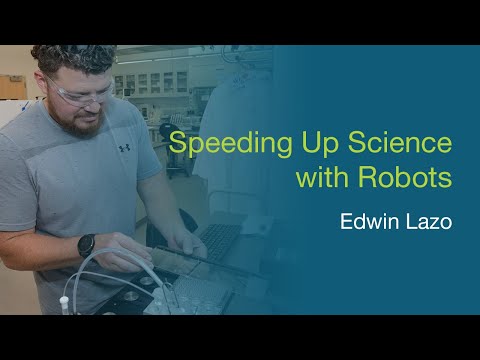
Edwin Lazo, a scientist at the National Synchrotron Light Source II, described how robotics and automation at NSLS‑II are increasing the speed and scale of x‑ray crystallography used to validate protein structures for drug discovery.
Lazo told listeners the automated workflow — in operation since March 2017 — mounts samples, centers them on the beam, runs an AI‑assisted raster to find the best area and collects data without a human operator. "The robot is going to mount a sample ... it's then going to send center the sample to the beam," he said, summarizing the automated sequence.
Why it matters: Lazo invoked the 2024 Nobel Prize awarded to David Baker for AI protein design as an example of how fast structural validation can accelerate therapeutics. He said NSLS‑II used x‑ray crystallography to confirm AI‑predicted structures and reported that fully automated collections can identify when a drug is bound to its protein target.
The lab has layered several innovations on the robot workflow, including AI loop centering and AI‑powered rasters, remote controls for both the robot and the door, machine‑vision sample tracking and liquid‑nitrogen monitoring. Lazo said safety and reliability measures include alarms that alert floor coordinators ("FLOCCOS") during overnight runs and sensors to ensure samples remain cryogenic.
Lazo provided a reliability figure for the automated operation: "for every 2,000 samples, you will lose 0.8 samples," a metric he presented as part of efforts to make overnight automation dependable.
The talk also covered new user access modes enabled by automation. In "classic" mode, researchers mail samples and remotely control experiments themselves. In hybrid mode, NSLS‑II collects data automatically overnight and researchers later inspect results and decide which samples need human attention. In standby mode, the facility collects data using its automated workflow with no human involvement. Lazo said these modes helped NSLS‑II accommodate users from the Advanced Photon Source while that facility was offline for upgrades.
Throughput gains were a central point. Lazo said standby mode brought throughput from about 5,500 to 9,000 samples per cycle (a cycle he defined as one third of a year), and hybrid mode later increased throughput to roughly 13,000 samples per cycle. He noted some samples are proprietary and that companies also use the facility for drug discovery.
Operational changes to support higher throughput include a booking app for self‑scheduling, Microsoft Forms to request standby mode, barcoded sample holders (pucks) scanned into the robot door to link samples to experiment parameters, and recent acquisitions such as a crystallization robot aimed at producing more samples using less protein. Lazo said the team is also developing room‑temperature mounting to reduce the need for on‑site manual mounting for those experiments.
He closed by thanking the Center for Biomolecular Structure, led by Sean McSweeney, the data science and systems integration division, and the accelerator division, whose floor coordinators help with overnight operations. "Thank you for watching," he said.
The presentation emphasized technical capability, safety measures and user‑facing changes intended to make high‑throughput, automated structural biology more reliable and accessible.