Get Full Government Meeting Transcripts, Videos, & Alerts Forever!
Get email alerts on the Ohio V Epa topic
No spam. Unsubscribe anytime.
ACUS panel: Ohio v. EPA heightens courts' scrutiny of agency comment responses, panelists say
Summary
A panel convened by the Administrative Conference of the United States unpacked the Supreme Court's 5-4 stay in Ohio v. EPA, focusing on the Court's finding that EPA inadequately responded to public comments, the role of severability, and potential downstream effects on agency rulemaking and judicial review.
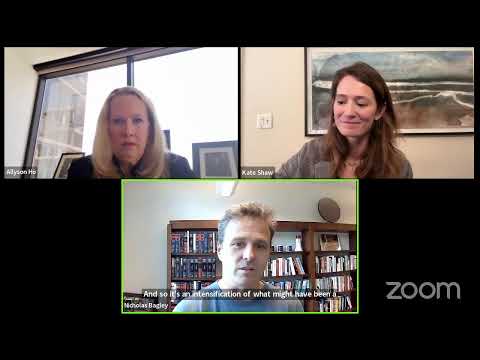
Andy Foyce, chair of the Administrative Conference of the United States, opened a virtual ACUS forum on the implications of major administrative-law rulings, concluding with a panel that examined the Supreme Court's stay of the Environmental Protection Agency's Good Neighbor Rule in Ohio v. EPA.
The panel's moderator, Kate Shaw, introduced legal scholars and agency officials who debated what the 5-4 decision means for agency practice. Steph Tatham, OMB's government member to ACUS, gave the factual background: "Under the Clean Air Act, states created state implementation plans known as SIPs," she said, and EPA disapproved plans for 23 states and promulgated a federal implementation plan (FIP). Tatham said EPA estimated "that in the year 2026, the final Good Neighbor Plan will prevent up to 1,300 premature deaths," reduce hospital visits and absenteeism, and that those benefits would continue through 2042.
The Supreme Court granted a stay, with a majority opinion by Justice Gorsuch that concluded EPA had not "reasonably explained" the plan and had failed to respond to public commenters who argued the rule would require reassessment if not all 23 states participated. The majority criticized EPA's final rule for not explaining why the number and identity of participating states would not affect the measures that maximize downwind air-quality improvements. The Court also rejected EPA's severability explanation that the rule could continue to operate "without regard to the number of states participating."
Panelists disagreed about whether the ruling represents a narrow procedural application of settled law or an intensification of judicial review. Professor Nick Bagley said the decision is "strictly speaking, it's a procedural error" in that the Court found EPA failed to respond to a specific comment, but he warned "there may be some substantive concerns lurking underneath" and that the opinion could encourage lower courts to scrutinize agencies with heightened detail. Bagley cautioned that the decision may create incentives for litigants and courts to "fly-speck" agency explanations.
Lisonbee Ho, a partner at Gibson Dunn and ACUS senior fellow, emphasized the majority's focus on meaningful opportunity to be heard under the Administrative Procedure Act: "How do you know if you've been heard? You're the agency. And that is you get a response from the agency that addresses your concern," she said, arguing agencies must do more than a perfunctory acknowledgment when commenters raise weighty concerns.
The panel also examined the decision's procedural posture. Several panelists noted Ohio v. EPA reached the Supreme Court on an emergency application and was argued after substantial briefing; that posture raised questions about how broadly lower courts should treat the ruling as precedent. Bagley and others observed the Court's recitation of traditional stay factors but said modern practice often places outsized weight on "likelihood of success" and effectively conducts a merits preview at the stay stage.
On remedies and severability, Bagley and others discussed alternatives to full vacatur, including remand without vacatur. Bagley said remand without vacatur can be an appropriate, softer tool when an agency's explanatory failure appears fixable without altering the substantive policy. Matt Glooth, ACUS deputy research director, highlighted ACUS's Formal Recommendation 2018-2 on severability, which urges agencies to identify potentially severable parts early in rulemaking, address severability in notices of proposed rulemaking and final rules, and provide clear reasoned explanations to make severability arguments more persuasive in court.
Panelists said the ruling is likely to change how agencies and courts approach notice-and-comment disputes, even if it did not formally announce a new legal standard. Allison (Lisonbee) Ho and Bagley agreed that agencies face a difficult choice: increase the resources spent drafting more granular responses to comments or accept that the courts may demand further explanation and that litigation delays and stays remain possible.
The session closed with audience questions about whether State Farm remains good law, the precedential weight of the stay, and the appropriate scope of judicial remedies. Bagley noted remand without vacatur is a common DC Circuit practice to soften remedies where appropriate, while other panelists stressed the continuing importance of addressing weighty comments with meaningful, reasoned explanation. Chair Foyce closed by pointing listeners to ACUS resources and recorded videos at acus.gov.
The forum underscored a central tension: courts insist agencies provide reasoned responses to salient public comments, while agencies face practical limits on how exhaustively they can respond to high-volume notice-and-comment records. Panelists urged clearer severability statements and more focused explanations on core, weighty issues but warned that no single drafting fix guarantees immunity from intensified judicial scrutiny.