Get Full Government Meeting Transcripts, Videos, & Alerts Forever!
Get email alerts on the Nevius Data Center topic
No spam. Unsubscribe anytime.
City briefed on Nevius data‑center campus, linked ESA/PPA and IPP power plan; council presses for water and transmission details
Summary
City staff described a proposed Nevius data‑center campus on nearly 400 acres and linked agreements with Independence Power Partners that would add generation capacity in phases. Officials said contracts (ESA/PPA) were executed and designed to shield resident rates; councilors requested independent water‑use verification and more transmission details.
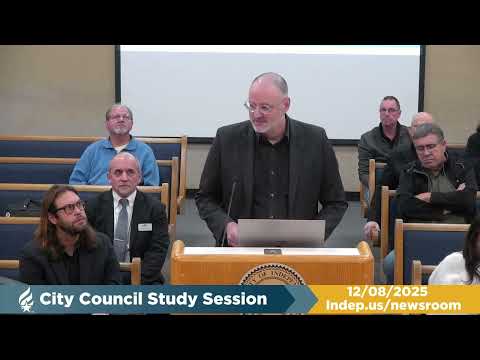
City staff used a Dec. 8 study session to brief the council on a proposed Nevius data‑center campus and the companion power‑generation plan overseen by Independence Power Partners (IPP).
Charlie DeSalle, assistant city manager, said Nevius (a NASDAQ‑listed company, transcript variously spelled) closed on just under 400 acres at Loop Parkway and Missouri 78 and plans a campus of up to 10 buildings and approximately 2.5 million square feet, developed in stages over three to five years. "Nevius has indicated that they will use a closed looped cooling system," DeSalle said, describing the company’s commitment to minimize water consumption.
The data center’s power and rate arrangements are tied to two contracts: a power purchase agreement (PPA) between Independence Power and Light (IPL) and Independence Power Partners, and an energy services agreement (ESA) between IPL and Nevius. City staff said both agreements were executed after Nevius closed on the land and that authorizations in executive session were consistent with Missouri statute section 610.021 because negotiations involved sealed proposals and contracts.
Joe Hagenefer, IPL director, explained the deal structure: capacity charges are a pass‑through from IPP, energy charges flow from the Southwest Power Pool (SPP) and are billed through IPL, and IPL will impose demand and other fees to recover transmission and upkeep costs. Officials repeatedly stated the agreements were written to avoid placing city or IPL debt on the municipality and to prevent negative rate impacts on residential customers.
Key numbers and timelines: staff described initial site/land/site improvement costs of about $6.6 billion in the transcript and "tens of billions" of equipment investment that will be refreshed roughly every five years. The campus is intended to support at least 800 megawatts of data‑center operations; IPP’s first‑phase power plant was described as ~225 megawatts (15 turbines) with expansion in a second phase up to ~800 megawatts. DeSalle and Hagenefer said Nevius will begin paying for 100 megawatts starting October 2026 and 200 megawatts in April 2027, with the first phase of generation online around October 2027.
Council concerns: several councilors asked for an independently verified, site‑specific water‑use model before approving final agreements. Staff said city average daily water production is about 28,000,000 gallons per day (capacity up to 48,000,000/day) and that preliminary estimates indicate the project should be within capacity, but staff committed to further review with municipal services and the water division.
Economic and tax impacts: staff said the city and IPL could each see pilot (payment‑in‑lieu) revenues in the $10–15 million range annually for phase 1 and $25–40 million for phase 2, with combined potential revenues to the general fund and IPL in a five‑year window estimated at $35–$55 million annually.
Related power developments: staff also updated the council on early feasibility studies to expand the Dogwood Energy Center in Pleasant Hill. The engineering evaluation has narrowed to two simple‑cycle turbines in an initial planning estimate (500–520 MW total) that could put IPL’s 12.3% share at roughly 61–64 MW, with an online target around 2032 if owners proceed.
Next steps: DeSalle said Nevius submitted a Chapter 100 tax‑abatement plan that the city will review in the new year; administrative approvals, a Bly Road relocation and right‑of‑way actions, site plan and building permits remain before construction. Councilors pressed for continued transparency, independent verification on water, and detailed transmission and transformer availability plans before further approvals.
No formal council action was taken at the study session.