Get Full Government Meeting Transcripts, Videos, & Alerts Forever!
Get email alerts on the Asset Management topic
No spam. Unsubscribe anytime.
Independence adopts RoadAI for annual pavement scoring; staff say it speeds project delivery and reduces survey costs
Summary
City staff told the Street Improvement Oversight Committee that switching to an annual RoadAI pavement scoring service reduced survey costs and allowed the city to assemble a Geobond overlay contract for roughly 50'160 miles in under four months, and they described how PCI guides maintenance choices.
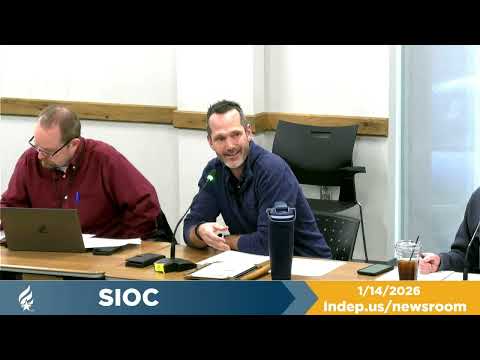
At its Jan. 14 meeting, the Street Improvement Oversight Committee heard a technical briefing on the Pavement Condition Index (PCI) and the city's new RoadAI pavement-survey system, which staff said provides annual condition data at a fraction of the cost of five-year external surveys.
Zane McKinney, assistant director of municipal services, told the committee PCI is an ASTM-standard score used across the industry to rate pavement from 1 to 100 and to guide whether streets need crack sealing, chip seal, microsurfacing, mill-and-overlay or full reconstruction. He said preventative maintenance performed earlier is much less expensive than later full reconstruction and that PCI helps make those trade-offs.
McKinney said the city moved from contracting five-year PCI surveys (about $250,000 every five years) to an annual RoadAI subscription that costs about $27,000 a year. "That program costs us, about $27,000 instead of, dollars $250,000 every 5 years," he said, adding the city now receives updated data yearly and can evaluate contractor or developer repairs more quickly.
As an example, McKinney described a recent dispute where a contractor'built health services facility tore up nearby streets during work. Using RoadAI imagery taken three weeks before the contractor began, staff met with the contractor and within about 20 minutes the company agreed to take responsibility for repairs it had initially refused. "Within about 20 minutes in that meeting, they had gone from, no, we're not doing this, to okay, you got this," McKinney said.
Staff said RoadAI also allowed the city to assemble a Geobond overlay contract for roughly 50'160 miles of overlay work in under four months, a process they said previously took many more months when relying on five-year survey cycles.
Committee members asked practical questions about coordination with water-main replacements and about how PCI data flags small but important local defects; staff said they try to combine water-main replacement work with street projects to avoid repeated neighborhood disruption and prioritize mains by break frequency and impacts to critical facilities.
What's next: Staff will continue to use RoadAI for annual condition monitoring, provide before-and-after PCI measurements for completed projects and include PCI-derived maps with upcoming Go Bond project materials.