Get Full Government Meeting Transcripts, Videos, & Alerts Forever!
Get email alerts on the State Budget Emergency Omnibus topic
No spam. Unsubscribe anytime.
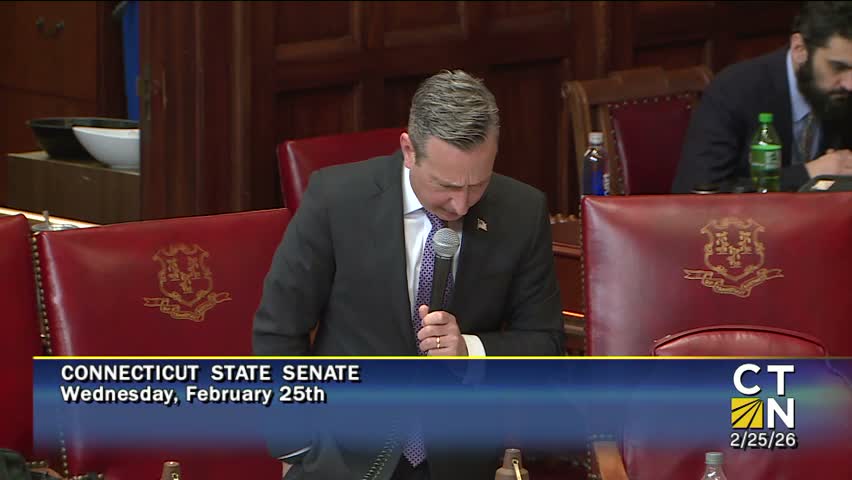
Senate approves emergency-certified omnibus bill after hours of debate and failed amendments
Summary
After hours of floor debate and a series of failed amendments, the Connecticut Senate passed emergency-certified Senate Bill 298 — a broad reallocation-and-policy omnibus covering education, public safety, labor protections, and targeted appropriations — on Feb. 25, 2026 by a roll call of 26–10.
The Connecticut State Senate passed Senate Bill 298, an emergency-certified omnibus bill that reallocates state funds and enacts changes across education, public safety, labor and other areas, after extended debate and multiple failed amendments.
Opponents repeatedly challenged the use of emergency certification, saying the package bundles unrelated measures and circumvents public hearings. “That’s not an emergency,” Senator Harding said during floor debate, arguing the bill contains items that are not time‑sensitive and that the process denied constituents opportunities for comment. Proponents responded that Connecticut General Statutes §2‑26 and joint rule 9 allow leaders broad discretion to certify an emergency; Senate leadership and precedent were cited on the floor in support of that interpretation.
The bill contains numerous sections explained on the floor: targeted appropriations (including a $70,000 clarification for the Village Initiative Project in Bridgeport and a $330,000 grant to a Hartford-area youth services group called Our Piece of the Pie); school‑focused adjustments (school‑based mental‑health funding, kindergarten waiver changes, updates to suspension/expulsion language and crisis‑response drills); an increase to Medicaid rates for intermediate care facilities in later fiscal years; workforce safeguards restricting certain warehouse quota practices and granting employees access to quota records; and a set of child‑support amendments intended to address federal compliance concerns.
A series of amendments offered during the floor session were defeated by roll call votes. Notable attempts included: - A Republican amendment (LCO 2239) proposing large income‑tax and payroll‑tax cuts and elimination of many occupational licensing fees; it failed (11 yeas, 25 nays). - An amendment to exempt common school supplies from the sales tax (LCO 2242) was debated and defeated (11–25). - An amendment to eliminate the income tax on Social Security income (LCO 2244) also failed (11–25). - Several transparency and earmark‑disclosure amendments (including LCO 2258) seeking mandatory requester disclosure, public hearings and random audits for grant recipients were offered and defeated. - An amendment (LCO 2293) to remove the bill’s child‑support tolling provision for incarcerated domestic abusers failed following debate about potential federal penalties for noncompliance with TANF and child‑support enforcement rules. - An amendment (LCO 2297) to clarify Public Utilities Regulatory Authority (PURA) authority over a proposed sale of Aquarion Water Company was debated but did not pass (9–26, 1 absent).
After the amendment votes and final debate, the Senate held a roll‑call vote on the bill itself. The clerk recorded 36 senators voting; the bill passed 26–10. The presiding officer then ordered immediate transmittal of the emergency certified bills and consent‑calendar items to the House.
What happens next: The bill now proceeds to the House for its consideration. Where the bill contains appropriations or changes requiring additional implementation steps, affected agencies and local districts will receive further instructions or guidance tied to the enacted language.
Reported authorities and legal bases cited on the floor include Connecticut General Statutes §2‑26 and references to joint rule 9. Senators on both sides urged further committee review on several contested topics even as the full chamber concluded its vote.