Get Full Government Meeting Transcripts, Videos, & Alerts Forever!
Get email alerts on the Ab 2011 Labor topic
No spam. Unsubscribe anytime.
Carpenters push living‑wage proposal as AB 2011 sponsors and developers debate feasibility
Summary
At an Assembly outcomes review, Danny Curtin of the California Conference of Carpenters urged a livable residential wage plus health benefits for private‑market projects, arguing enforcement and underground cash pay remain problems; developers and housing advocates favored preserving prevailing wage for subsidized projects while exploring targeted fixes to improve feasibility for mixed‑income development.
Labor representatives, bill sponsors and developers used the AB 2011 outcomes review to press competing priorities over wages and feasibility in California housing construction.
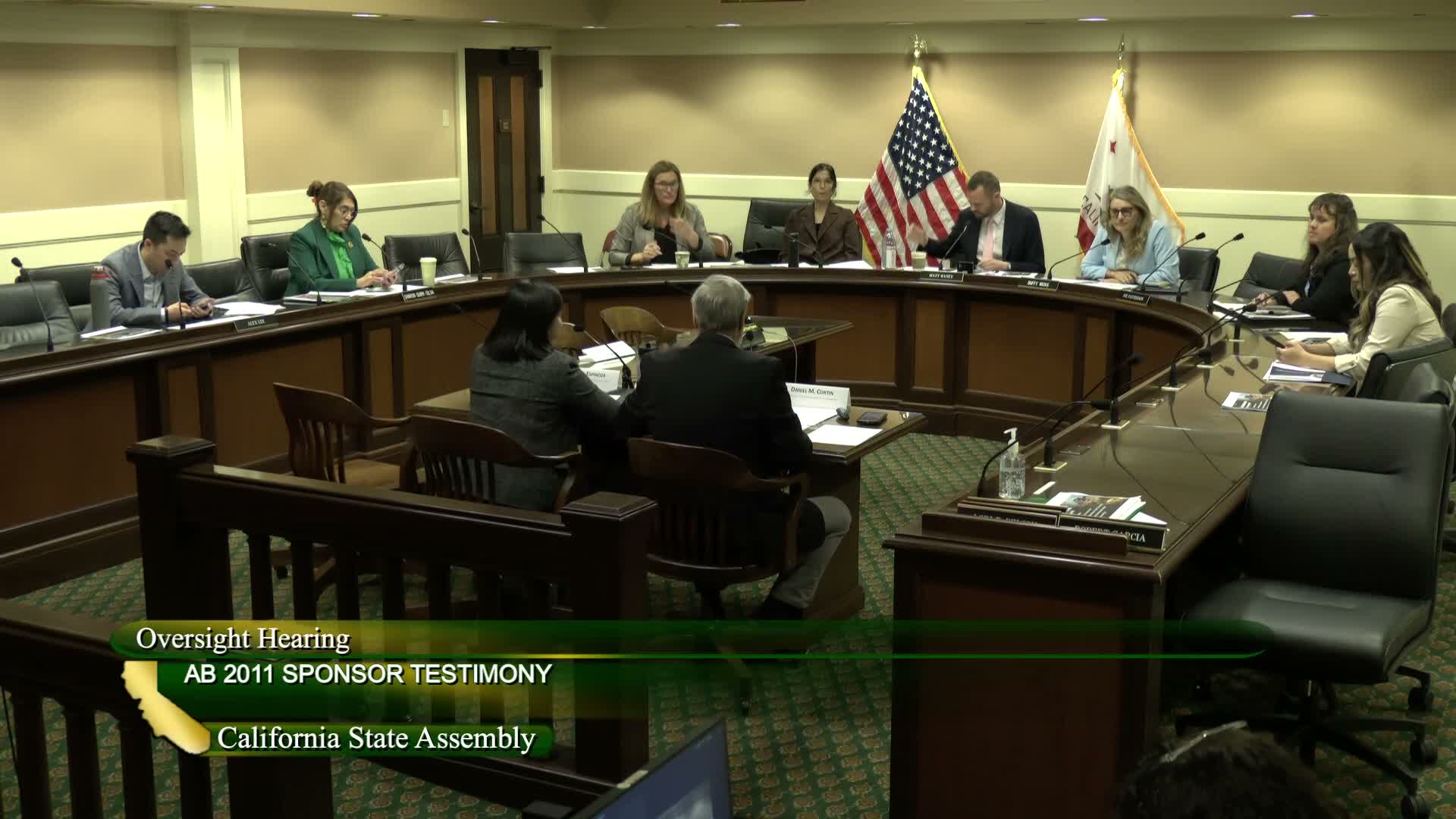
Danny Curtin of the California Conference of Carpenters told the committee industry conditions in private‑market housing are "the wild west," with cash pay and weak enforcement. Curtin urged consideration of a geographically variable livable minimum residential wage with health‑care provisions for private‑market projects, saying such a standard would raise pay, bring payroll into the tax system and reduce the government subsidy that current low wages effectively create for workers.
Curtin acknowledged prevailing wages remain appropriate where public funding already triggers them, and he did not propose changing prevailing wage for publicly assisted projects. But he argued full prevailing wages make many private‑market mixed‑income projects infeasible in today’s cost environment, and proposed an intermediate standard that could improve both worker outcomes and project feasibility in some markets.
Developers and other panelists described the tradeoffs. Land‑use attorney Dan Golub and Will Goodman said prevailing wages and a strict inclusionary requirement are significant cost drivers; in high‑cost, high‑rent markets some projects can absorb those costs, while in other jurisdictions the economics do not pencil. Jason Moody’s market presentation illustrated how prevailing‑wage and inclusionary layers can eliminate residual land value in a Silicon Valley example.
Marina Espinosa of the California Housing Consortium said supporters of AB 2011 balanced streamlining with labor protections and urged lawmakers to explore creative solutions — including targeted subsidies, enforcement improvements, and reliable housing funding — that both reduce construction cost barriers and preserve labor standards.
No policy change was adopted at the hearing. Lawmakers signaled a willingness to continue conversations among labor, developers and housing finance advocates to identify options that preserve worker protections while improving feasibility for mixed‑income projects in more parts of the state.