
Assembly hearing finds modest early use of AB 2011, highlights barriers to wider adoption
Get AI-powered insights, summaries, and transcripts
Subscribe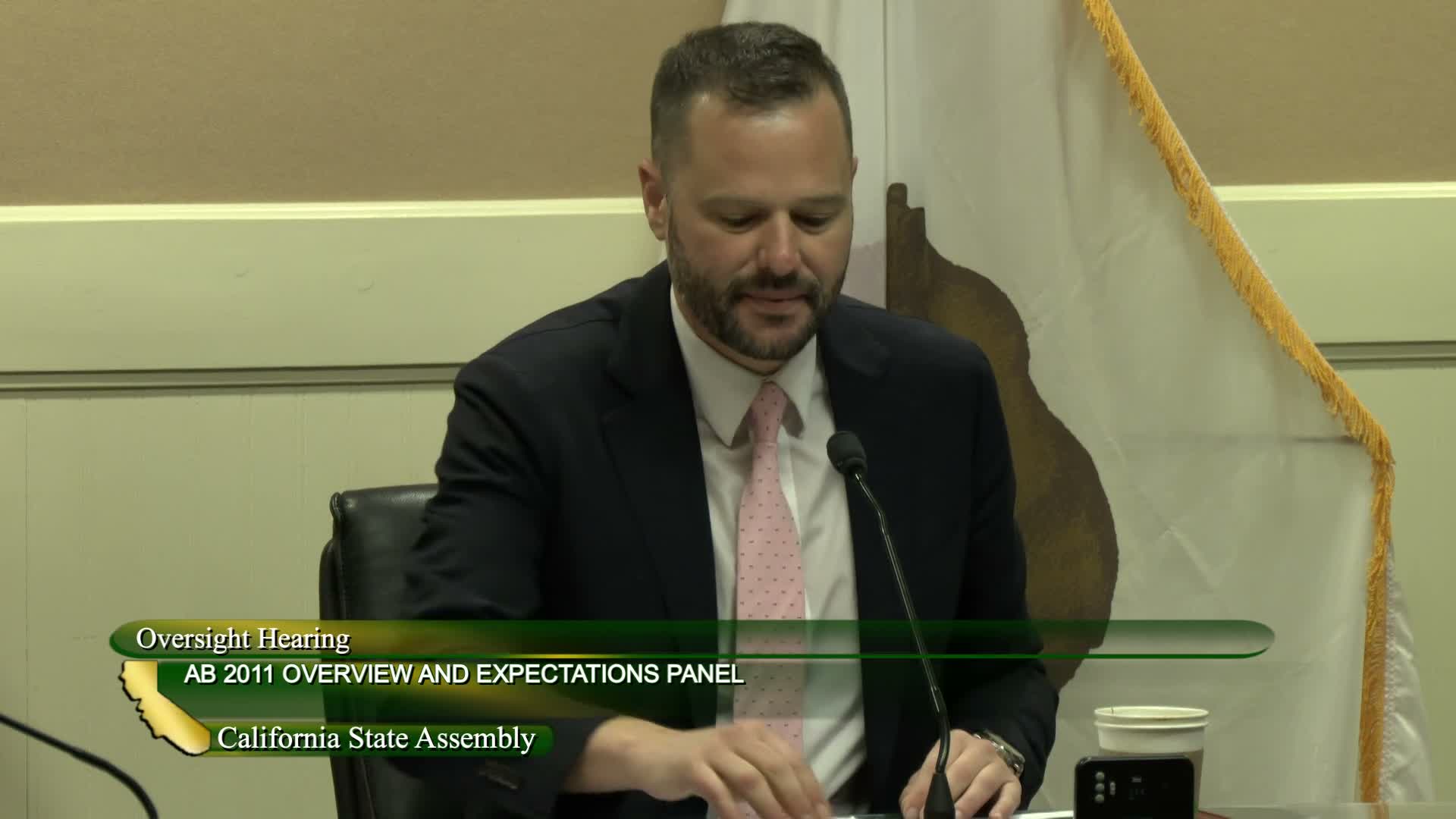
Summary
A California State Assembly outcomes review found AB 2011 has produced roughly 5,800 proposed/entitled homes through 2024, has been especially useful for 100% affordable projects, but faces feasibility barriers in mixed‑income markets because of prevailing‑wage and inclusionary requirements, site‑eligibility rules, and current market conditions.
A legislative hearing on AB 2011 on Feb. 27 reviewed early outcomes of the Affordable Housing and High Road Jobs Act of 2022 and found limited statewide uptake so far, with activity concentrated in San Francisco and other high‑rent markets.
The hearing, convened by the Assembly housing committee, heard expert and practitioner testimony that about 5,800 homes have been proposed, entitled or permitted using AB 2011 through 2024, with slightly more than half identified as affordable, according to UC Berkeley Turner Center analysis presented by David Garcia. Garcia cautioned that the APR (annual progress report) data used for that estimate are lagged and sometimes incomplete.
Panelists agreed the law has already been valuable for 100% affordable projects. Land‑use attorney Dan Golub and nonprofit developer Betsy McGovern Garcia said the bill’s ministerial pathway and CEQA relief have shortened entitlement timeframes and enabled projects in both urban and rural communities to advance more quickly.
But economists and market analysts warned the law’s mixed‑income track has seen only modest direct uptake. Jason Moody of EPS showed market data indicating rising construction costs, higher cap rates and flat rents that compress development margins; he and other presenters said the combination of the bill’s prevailing‑wage obligation and a 15% inclusionary requirement can push many mixed‑income projects into infeasibility under current market conditions. Moody offered a market example where adding prevailing wage and inclusionary requirements eliminated a viable residual land value in a Silicon Valley scenario.
Speakers identified additional operational barriers: narrow site‑eligibility definitions (for example the 75% "substantially surrounded" threshold and exclusions for certain industrial or high‑fire‑severity parcels), unclear definitions of corridor boundaries (questions about medians), and the statute’s minimum‑density rules, which can block townhome or mixed‑tenure projects that might otherwise pencil.
Panelists proposed fixes lawmakers could consider: targeted subsidies for the inclusionary component in mixed‑income projects, tax abatement parity for mixed‑income projects, clearer HCD guidance or statutory clarification on site criteria, relaxation of certain exclusions (for proximity to freeways or industrial adjacencies) or thresholds, and greater flexibility for homeownership and subdivision approvals under the streamlined pathway.
Advocates and developers at the hearing also urged continued investment in financing tools — including low‑income tax credits, the multifamily housing program and a proposed housing bond — to move entitled projects across the finish line. Several testimony points stressed that entitlement alone does not guarantee construction without reliable funding.
The committee did not take any formal votes. Members and witnesses said the hearing is the first of several outcome reviews; the chair and author signaled intentions to pursue technical 'cleanup' legislation and further oversight to make the law more useful statewide.
"This hearing is not about relitigating the bill. It is about measuring outcomes," the chair said at the opening. "If something isn't working, we should understand why."