Panel advances bill to let Maine charge application fees for degree‑granting institutions; amendment sought for College of the Atlantic
Loading...
Summary
The Education and Cultural Affairs Committee advanced LD 2098, a Department of Education bill that would authorize application fees for degree‑granting institutions to help the state scale reviews and protect students; the sponsor also proposed changing College of the Atlantic's private & special law to broaden its degree authority.
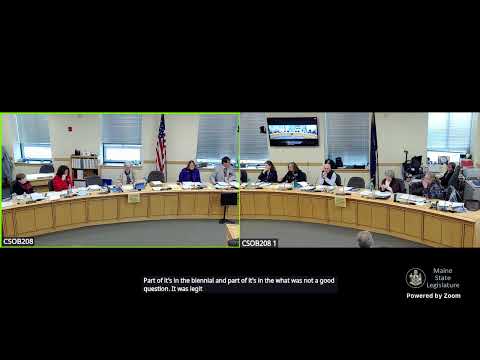
Sen. Jo Rafferty (Senate District 34) convened a work session in which committee staff reviewed LD 2098, an education department proposal to update statutes governing degree‑granting authorization and to permit the department to charge application fees.
Karen Neto of the Office of Policy and Legal Analysis summarized the bill, saying it would allow degree‑granting institutions to pay an initial application fee set by the commissioner of education and administered by the department. The department and a volunteer review committee would continue to oversee program reviews and deliver recommendations to the State Board of Education, which retains final authority to approve degree‑granting status.
Michael Perry, director of higher education and educator support services at the Department of Education, told the committee that a regional comparison shows only Maine and Vermont currently do not charge such fees; other states levy fees ranging from roughly $500 up to about $17,000 in New York. Perry said the aim is to set an initial, modest fee that builds review capacity and reduces the risk that Maine becomes a “free hit” for institutions that shop states for the lowest regulatory barriers. “Only Maine and Vermont do not charge fees for the Northeastern United States,” Perry said, adding that the department expects to peg initial fees to regional practice and adjust them by rule to avoid creating an undue barrier.
Perry and staff emphasized the bill does not strip the Legislature of its authority to grant degree‑granting status. He described a narrow scenario the bill addresses: where an institution recently gained temporary program approval and later seeks full institutional degree‑granting authorization; the State Board could still require a duplicative review if concerns arise.
Rep. Holly Sargent, sponsor of the bill, said she intends to offer an amendment that would alter College of the Atlantic’s private and special statute to broaden the college’s ability to issue bachelor’s degrees beyond a narrowly worded specialty. Karen Neto confirmed prior legislative practice shows similar private‑and‑special statutes have been amended in the past (for example, Husson College).
A motion was made to report LD 2098 out of committee as amended; the committee voted by hand. The transcript records the motion and the vote procedure but does not record a final tally in the public text.
What happens next: The committee moved LD 2098 forward for further consideration with the planned amendment to the private & special statute for College of the Atlantic. Staff will supply any outstanding comparative data and the formal fiscal and rulemaking analyses to inform subsequent votes and any legislative debate.