Get Full Government Meeting Transcripts, Videos, & Alerts Forever!
Get email alerts on the State Budget topic
No spam. Unsubscribe anytime.
Committee forwards executive‑branch budget (House Bill 500) after amendments
Summary
The House Appropriations and Revenue Committee adopted a committee substitute and an amendment to House Bill 500, funding a 2% salary increase in FY27 and FY28, exempting Medicaid benefits from broad cuts, and adding targeted capital and program funding; the bill was reported favorably to the full House.
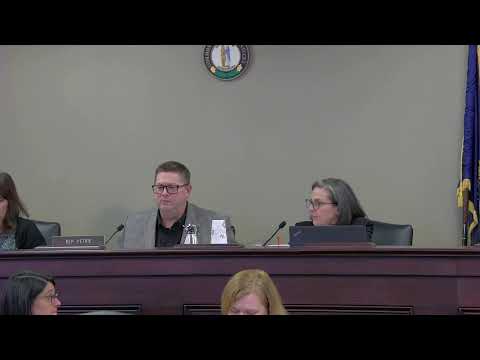
Chair Petrie opened the Feb. 25 committee meeting and summarized the committee substitute to House Bill 500 and a linked committee amendment, saying the bill was intended as a starting point for budget conversations with agencies.
The substitute includes a 2% salary increment for executive‑branch employees in FY27 and another 2% in FY28. Chair Petrie also described broad, formulaic cuts (4% in FY27 and an additional 3% in FY28) with an explicit list of exemptions, including veterans affairs, judgments, school facilities construction, county costs, Medicaid benefits, behavioral health, juvenile justice, corrections, and the postsecondary performance fund.
On education funding, Chair Petrie said SEEK was removed from the base‑percentage cuts and cited FY26 per‑pupil guarantee figures (about $4,586), projecting $4,626 for FY27 and $4,792 for FY28 under the committee draft. The committee also preserved transportation funding calculations based on FY26 numbers.
The committee exempted Medicaid benefits from the broad cuts and added funding for waiver slots and program support. Chair Petrie summarized several increases for health and public safety: roughly $55–56 million in restricted funds for Medicaid benefits program support in FY26, about $213 million per year in federal funds for rural health transformation, authorization of roughly $270 million in bond funds for a central laboratory expansion, and capital and maintenance appropriations for corrections, state police, the Northern Kentucky medical examiner, and other projects.
Representative Bogdanowski asked whether the SEEK transportation funding line (about $398.8 million in the substitute) represented full funding; Chair Petrie said the figure is based on FY26 numbers and noted updated numbers from the Kentucky Department of Education were expected soon. When asked about the $487.7 million general‑fund and $350 million Department of Insurance deposits referenced for the budget reserve trust fund, Petrie described those deposits as safeguards and said parts of the $350 million are being held as callable backup for Medicaid pressures rather than treated as operational revenue.
Representative Berg queried why the committee's Medicaid benefits appropriation was roughly $220 million less than the governor's request. Petrie said the committee set benefits at FY26 funding levels because recent trends show a decline in eligibles; he added that a Medicaid Oversight Advisory Board and new reporting requirements should allow month‑to‑month monitoring and a return to committee discussion if projections change.
A committee member moved and the committee adopted the committee amendment to PHS 1 and then adopted PHS 1 as modified. Chair Petrie then called a roll; the committee reported HB 500 as amended with a favorable expression and indicated it should pass on the floor.
The committee did not finalize every line item in public debate; Petrie noted the substitute is the start of broader negotiations with the Senate and that conference committee work is expected to resolve interchamber differences.
The committee is scheduled to send the substitute to the full House; next procedural steps are floor consideration in the House followed by Senate action and, if necessary, a conference between chambers.