
Appeals court hears arguments over whether discharge before patient’s death should have gone to jury
Get AI-powered insights, summaries, and transcripts
Subscribe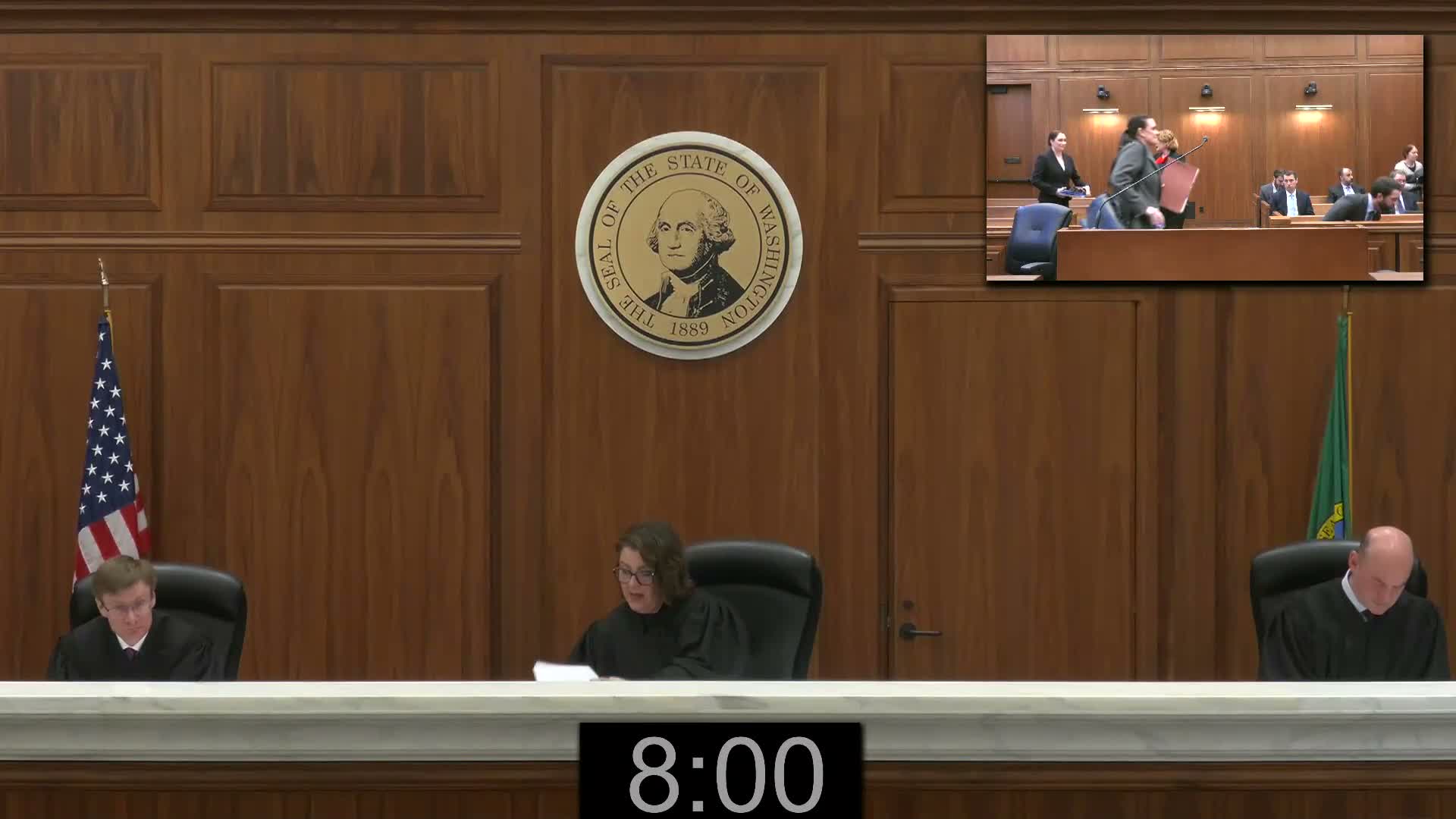
Summary
Appellate counsel in Williams v. PeaceHealth debated whether a trial court improperly granted summary judgment in a wrongful-death suit after a hospital discharge; the estate’s lawyer said conflicting expert opinions create a jury question while defense counsel argued gross negligence was not shown under the Involuntary Treatment Act.
The state appellate panel heard oral argument in Williams v. PeaceHealth over whether the trial court erred by granting summary judgment to Dr. Manzo and his employer after Craig Williams was discharged and later died.
Caligi O'Brien, counsel for the estate of Craig Williams, told the panel that the treating physician predicted Mr. Williams’ death less than an hour before it occurred and that competing expert testimony creates a genuine issue of material fact that must be decided by a jury. “Conflicts in expert testimony are for the jury to resolve, not the court,” O’Brien said, arguing that Dr. Cummins’ declaration — which, she said, concluded the “minimum policy that the hospital required was not done” — is sufficient to defeat summary judgment when viewed in the light most favorable to the estate.
O’Brien stressed that Dr. Cummins concluded Dr. Manzo failed to recognize that Mr. Williams was gravely disabled and did not document such a finding in the chart. Counsel argued the record shows Mr. Williams had swallowed about 100 pills and that a suicide screening required by PeaceHealth policy was not completed before discharge. “There’s a patient who’s unable to care for himself based on the doctor’s own words,” O’Brien told the court, and she asked the panel to reverse the dismissal.
Amanda Thorzweig, counsel for respondent Dr. Manzo, replied that the trial court correctly applied the high legal standard for gross negligence and that a mere disagreement among medical experts — particularly from an expert who was not present at the time — is insufficient to send the case to a jury. “Gross negligence is a high burden,” Thorzweig said, adding that Dr. Manzo’s contemporaneous records show the physician concluded Mr. Williams was lucid and “non-detainable,” meaning he could carry out basic activities of daily living.
The panel questioned both sides about whether Dr. Cummins relied on materials not in the record, whether the plaintiff’s affidavit had been treated as a sham, and whether evidence introduced after the decision could be used to judge the physician’s contemporaneous choice. One justice observed that suicidality and the statutory concept of being gravely disabled are distinct inquiries under the Involuntary Treatment Act (ITA), and the lawyers debated whether the record supports a finding that Dr. Manzo met the statutory criteria for grave disability.
Thorzweig urged the court to play a gatekeeper role under precedent such as Harper v. Department of Corrections, arguing courts must consider the entire record and avoid imposing liability based on hindsight. O’Brien countered that Dr. Cummins did account for what Dr. Manzo did and did not do and that, even credited in part, the opinion supports a jury finding of gross negligence.
Counsel also discussed post-discharge events the estate says show causation: O’Brien said hospital staff turned Mr. Williams away when he sought to return, and that he was subsequently struck by three cars and killed. Defense counsel emphasized that the ITA favors liberty over involuntary detainment and that the contemporaneous medical notes and deposition testimony reflect the treating physician’s view that Mr. Williams did not meet the high threshold for involuntary detention.
The court heard argument on the record’s adequacy and the proper legal standard but did not announce a decision at the hearing. The panel’s ruling will determine whether the estate may proceed to trial on claims the discharge decision amounted to gross negligence under Washington law.