Appellate panel presses lawyers on whether claims‑services contract covers Integon in Yusupovic v. Entegon
Loading...
Summary
At oral argument, counsel for Integon asked the court to reverse summary judgment and remand so a jury can decide whether a claims‑services agreement (CSA) was intended to cover the insurer's subsidiary; judges sought proof that remaining trial claims are final before resolving appealability.
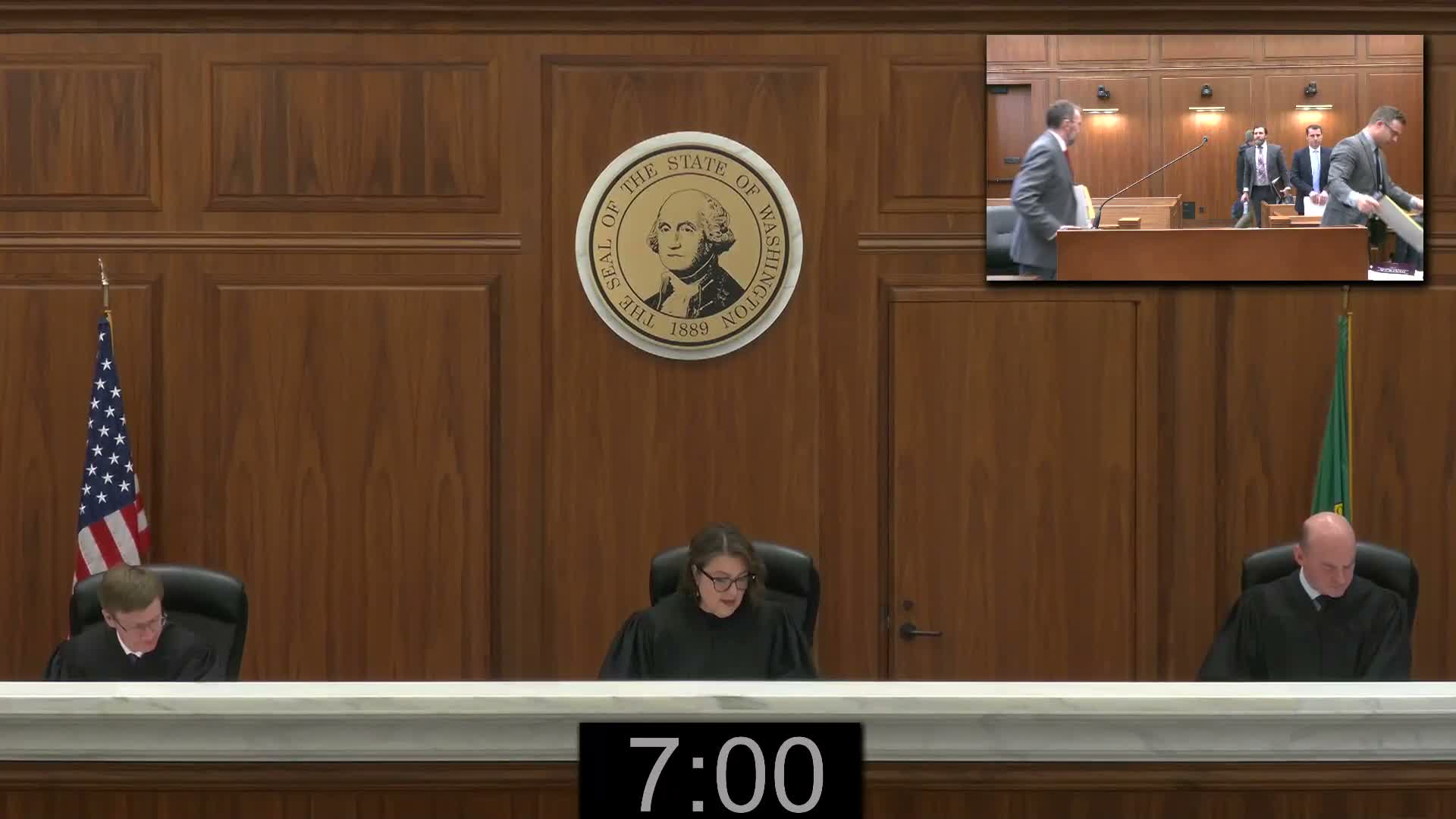
Elliot Harris, attorney for appellant Integon Preferred Insurance Company, urged the appellate panel to reverse the superior court’s grant of summary judgment and remand for trial on whether the parties intended the claims‑services agreement (CSA) to apply when Nationwide was hired to retain and supervise auto appraisers for claims under Integon policies. “We are asking this court to reverse the trial court's granting of summary judgment,” Harris told the panel.
The argument turned on two linked issues: appealability and contract interpretation. A member of the panel pressed Harris on whether plaintiff claims against a third party, Lighthouse, remain pending and asked counsel to file a declaration or other document proving those claims have been resolved so the court can determine whether it has jurisdiction to decide the cross‑claim appeal. Harris agreed to check the record and submit evidence showing finality.
Edward Westfall, representing Nationwide Appraisals, told the court the CSA is “clear, and unambiguous and integrated” and that Integon is not a party covered by the indemnity provision. Westfall argued that the appellant’s extrinsic evidence was speculative and insufficient to create a factual dispute that would defeat summary judgment, noting that indemnity clauses are “special creatures of contract law” to be construed strictly under Washington precedent.
Throughout the argument the panel and counsel debated whether the written definition of the contract’s defined term “client” (identified in the CSA preamble and indemnity paragraph as National General Management Corp.) could reasonably be read to include a subsidiary insurer such as Integon. Harris emphasized the familiar summary‑judgment standard—view evidence in the light most favorable to the nonmoving party—and pointed to course‑of‑performance material and an exhibit fee schedule that repeatedly showed a $115 entry for auto and motorcycle appraisals as indicia of how the parties treated the relationship in practice.
The panel asked detailed questions about admissibility and the role of extrinsic evidence, with one member observing that Washington law sometimes admits course‑of‑performance evidence to show what the parties actually agreed upon even if the written contract appears plain. Westfall countered that the CSA’s illustrative list in the indemnity provision (naming officers, directors and employees) and the contract’s assignment section undercut any argument that the agreement’s protections were intended to extend to an unrelated underwriting company absent a formal assignment.
Westfall also pointed the court to the clerk’s papers—roughly 430 pages of claims entries—saying only a small number of entries tried to tie Integon to appraisals and that there is no documented assignment of rights under the contract. Harris responded that the declarations and performance documents in the record create an issue of fact for a trier of fact on whether the contract’s definition of client should be read to include subsidiaries in practice.
The panel repeatedly returned to the procedural threshold: before reaching the merits, it asked counsel to cooperate in producing a short, attached document proving finality of the other claims so the court can confirm appealability. The court recessed after both sides agreed to follow up.
The panel did not rule at argument. The court ordered counsel to file proof of finality regarding the Lighthouse‑related claims; next steps will depend on whether the parties can show the record supports appellate jurisdiction and on the court’s later assessment of whether the extrinsic evidence creates a triable issue on the CSA’s scope.