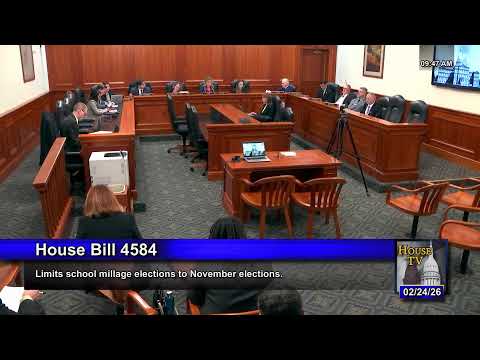
Committee hears bills to move local millage and bond questions to November elections; substitutes adopted to delay start dates
Loading...
Summary
Supporters of House Bill 4,583 told lawmakers moving millage and bond questions to the November general election would increase turnout and popular consent for new local taxes; the committee adopted substitutes pushing implementation dates to Jan. 1, 2027 and reported other bills with recommendations before adjourning.
Lansing — Witnesses and members of the House Committee on Election Integrity debated whether local millage and bond questions should be limited to the November general election.
Representative Maddock, speaking via Zoom in support of House Bill 4,583, said many local tax questions are placed on "hidden" May elections with low turnout and argued that "the more voters that participate in the political process, the better it is" and that moving such questions to November would give more people a voice.
Roger Belknap, who identified himself as a former county commissioner and former municipal public works director, told the committee he supported changes to "Public Act 206 of 1893" so that new or increased millages would come in the November ballot, saying the general election produces higher turnout and better-informed voters.
James Homan of the Mackinac Center for Public Policy said placing local tax questions on higher-turnout ballots strengthens "popular support" for taxation; he also cited comparative data on Michigan property-tax levels.
Committee members raised operational concerns: Representative Colazar and others asked how districts would handle fiscal-year gaps if a millage expired before a November vote; Representative Hoadley and Representative Wooden questioned whether moving all local questions to November would worsen already long ballots and whether primaries (August) could be an alternative. Witnesses and Representative Maddock responded that many local units can manage interim budget needs and that moving questions would adapt administrative timing in favor of broader voter participation.
Before adjournment, Chair Smith announced proposed substitutes to change the bills' start date from Jan. 1, 2026 to Jan. 1, 2027. Representative Fox moved to adopt a substitute for HB 4,583; the clerk called the roll and the motion prevailed (recorded as 9 yays, 0 nays). A similar substitute to HB 4,584 was also adopted with the same recorded result.
The committee also read witness registration cards for multiple organizations and later moved to report HB 5,467 and HB 5,468 with recommendation; those reporting votes were recorded by roll call before the committee adjourned.
The committee did not enact statutory language in the hearing; members requested additional fiscal and turnout data to evaluate operational impacts of moving local tax questions to November.