Get Full Government Meeting Transcripts, Videos, & Alerts Forever!
Get email alerts on the Taxes Fonce topic
No spam. Unsubscribe anytime.
Tennessee Revenue officials explain family‑owned exemption for franchise and excise taxes
Summary
Tennessee Department of Revenue staff summarized eligibility, filing and renewal rules for the family‑owned noncorporate (FONCE) exemption from franchise and excise tax, highlighted common application mistakes and answered questions on trusts, short‑term rentals, sales and refunds.
Billy Traud, a member of the Tennessee Department of Revenue’s taxpayer education section, opened a recorded webinar Wednesday to explain the family‑owned noncorporate election (FONCE) exemption for the state’s franchise and excise taxes and to answer taxpayer questions.
The department told attendees the exemption is grounded in statute (Tennessee Code Annotated §67‑4‑2008) and has two principal eligibility tests: at least 95% of an entity’s ownership units must be held by members of a qualifying family, and at least two‑thirds of the entity’s activity must come from holding or forming one or more personal residences (or from passive investment income, farming, or a combination of those activities). "If those qualifications are met, then we can consider that to be family owned," Traud said.
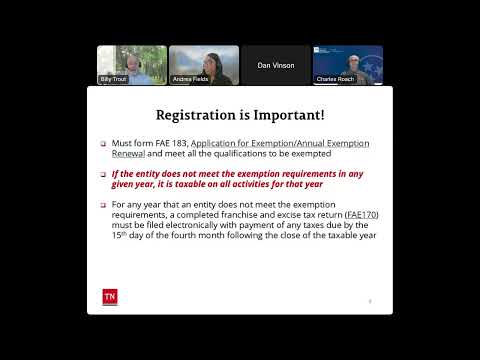
Why it matters: qualifying for FONCE can exempt an otherwise taxable entity from franchise and excise liability; failing to meet the tests means the entity is taxable for all activities in that year and must file a franchise and excise return.
Key requirements and common pitfalls
- Ownership and relationships: Traud reviewed who counts as family under the statute (ancestors, spouses including former spouses, lineal descendants and spouses of descendants, legally adopted children, and estates or trusts of qualifying deceased individuals). Panelists emphasized that application reviewers need the relationships between members clearly disclosed so the department can verify the 95% ownership requirement.
- Passive income and rentals: passive investment income includes rents from residential or farm property, royalties, dividends, interest, annuities and capital gains. Rental income qualifies only when derived from residential or farm property used for residential purposes; a location may not exceed four residential units to qualify under the residential rental rule.
- Trusts: Charles Roach of the department’s audit division said the type of trust that typically qualifies is a testamentary trust; living or revocable trusts generally do not qualify unless they meet the testamentary trust criteria.
Filing, deadlines and penalties
- Form and timing: taxpayers must use the department form FAE‑183 to apply or renew the exemption annually. For calendar‑year filers the filing deadline is the 15th day of the fourth month after the tax year end (for many taxpayers, April 15).
- Federal extension box and penalty: Andrea Fields in Taxpayer Services said filers granted a federal extension must mark the extension option on FAE‑183 (paper or online). "It is important that you select the option on the FAE‑183 that you have been granted the extension," Fields said, noting that failing to indicate an extension can trigger a $200 late‑submission penalty.
- Electronic filing and notifications: the department encouraged use of the online portal (TinTAP/Tintap as presented) to speed processing; approved or denied exemptions generate both a portal notice and a mailed letter. Processing is typically 24–48 hours outside peak season, but may take longer if additional review is required.
Application accuracy and audit risks
- Complete the Disclosure of Activity: Roach said the most frequent problem in audit is an incomplete Disclosure of Activity form (missing member relationships, misallocated passive vs. nonpassive income, missing addresses or county data). "If that is completed properly, it's a good possibility that audit will not have to request any information," he said.
- Distinguish exemption parts: the Disclosure of Activity has several parts; Part 1 applies to FONCE specifically, while taxpayers sometimes mistakenly complete the farming section (Part 2) when it does not apply.
Q&A highlights
- Short‑term rentals: Roach confirmed short‑term rental units can qualify when the structure meets the residential rules (four units or fewer at a location and used for residential purposes).
- Property sales: selling property during a tax year can create nonpassive gross receipts that push an entity below the two‑thirds passive income test for that year; eligibility can change year to year depending on income composition.
- Retroactive exemptions and refunds: Fields said taxpayers may apply retroactively for an exemption and, if approved, request reversal of previously filed franchise and excise returns and a refund, but the process may require multiple layers of review and patience.
Practical steps and contacts
Panelists urged taxpayers to: complete the FAE‑183 and Disclosure of Activity fully and legibly (or file online), indicate federal extensions when applicable, select the correct "new" vs. "renewal" option, and include EIN, franchise/excise account number and Secretary of State control numbers when relevant. For closing entities, check the "final" box to obtain termination tax clearance for the Secretary of State. For further help the department listed revenue.support@tn.gov, general assistance (615) 253‑0600 and franchise and excise support (615) 253‑0700.
The department said the webinar materials and recording will be posted in its taxpayer education webinar library and announced related upcoming webinars on franchise/excise and sales tax.