
Georgia committee hears divided testimony on brewery self‑distribution bill
Get AI-powered insights, summaries, and transcripts
Sign Up Free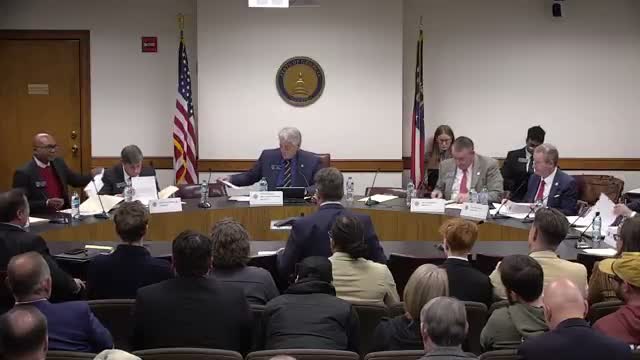
Summary
A Senate committee heard competing testimony on Senate Bill 456, which would limit small breweries to 3 cases per person per day and cap county sales at 500 barrels; brewers said it helps small businesses, while wholesalers and public‑health experts warned of retail displacement and increased alcohol‑related harms.
Senate members heard more than an hour of testimony for and against Senate Bill 456 on expanded direct‑to‑consumer beer sales, with supporters saying the bill helps small breweries grow and opponents warning of public‑health and market‑allocation risks.
The bill sponsor told the Regulated Industries and Utilities Committee the substitute (LC560599s) drops earlier language and narrows the proposal: it would cap off‑premise sales to roughly three cases per person per day and reduce a county sales limit from 1,000 barrels to 500. "We reduced this down to 3 cases a day and from 1000 to 500," the sponsor said while asking for the committee’s favorable consideration.
Small brewers testified in support. "This bill would mean a lot for our brewery and most breweries our size," said Chris Lauer, owner of Rock Solid Brewing in Ball Ground, who called his brewery an anchor of his three‑block town and said the measure would help them grow and gain publicity.
Opponents included a public‑health witness and wholesalers. Dr. Robert Brewer, a retired public‑health official and former director of the alcohol program at the Centers for Disease Control, urged rejection: "I think 456 is a bad bill that could do a lot of harm to our fellow Georgians," he told the panel, saying increased availability leads to greater consumption and a rise in alcohol‑related crashes, violence and long‑term health costs. Martin Smith, representing the Georgia Beer Wholesalers Association, argued the bill could allow retail replacement and "cherry‑picking" of prime local accounts; he warned the draft definition of small brewer could, in some wholesaler portfolios, include very large producers.
Supporters from the brewery community emphasized modest aims. Josh Mackey of the Georgia Craft Brewers Guild described the provision as an "on‑ramp" to demonstrate demand and reach a sustainable distribution scale, and testified that many craft brewers produce far less than 500 barrels annually and rely on small‑business financing.
Committee members focused on definitions and thresholds. Questions centered on whether the proposed 15% threshold tied to a wholesaler portfolio would unintentionally include large national brewers, and whether a production cap or revenue threshold (for example, barrels produced per year or a revenue cutoff) would be a clearer limit. Multiple witnesses suggested alternatives such as setting a barrel‑production cap or a revenue threshold to exclude major national brands while protecting neighborhood breweries.
Procedurally, the committee entertained a motion to pass but did not reach a definitive favorable vote on the floor that day; the sponsor said the bill could be further worked and the item was left on the table for additional refinement.
The committee did not adopt final language at this hearing; members signaled interest in tightening definitions (barrels, revenue levels or clearer exclusion language) before a future vote.